

Wagging the Moondoggie, Part II
October 1, 2009
by David McGowan
“Well,”
you now say, “what about all those cool Moon rocks? How did
they
get those? The Moon is, you know, the only source of Moon
rocks, so
doesn’t
that prove that we were there?”
No, as a matter of fact, it does not
prove
that we
were there, and as odd as it may sound, the Moon is not the
only source
of Moon
rocks. As it turns out, authentic Moon rocks are available
right here
on Earth,
in the form of lunar meteorites. Because the Moon lacks a
protective
atmosphere, you see, it gets smacked around quite a bit, which
is why
it is
heavily cratered. And when things smash into it to form those
craters,
lots of
bits and pieces of the Moon fly off into space. Some of them
end up
right here
on Earth.
By far the best place to find them is
in
Some skeptics have said that it is
possible
that
Moon rocks could have been gathered from the Moon with robotic
probes.
But
while it isn’t being argued here that unmanned craft haven’t
reached
the Moon,
it seems virtually inconceivable that any unmanned spacecraft
could
have landed
on and then been brought back from the surface of the
Moon in
the 1960s
or 1970s. There is no indication that it can even be done
today. It’s
been more
than three decades since anyone has claimed to do it, and that
claim,
by the
Soviets, is highly suspect.
What is known for sure is that even
some of
the
‘debunking’ websites have, albeit reluctantly, acknowledged
that
meteorite
samples gathered from
Such was the case with a ‘Moon rock’
that the
Dutch
national museum has been carefully safeguarding for many years
now,
before
discovering, in August of 2009, that they were in reality the
proud
owners of
the most over-insured piece
of petrified wood
on the planet. The ‘Moon rock’ had been a gift to the Dutch
from the
U.S. State
Department, and its authenticity had reportedly been verified
through a
phone
call to NASA. I’m guessing that NASA was probably running low
on
meteorite
fragments and figured the Dutch wouldn’t know the difference
anyway. Or
maybe

This is not to suggest, of course,
that all
of the
Moon rocks passed out by NASA and the State Department are
obvious
fakes. Most,
presumably, are of lunar origin – but that doesn’t necessarily
mean
they were
gathered by American astronauts walking on the surface of the
Moon;
they could
just as easily have come to Earth as meteorites. It is also
possible
that they
are of otherworldly origin but not from the Moon at all – such
as
meteorites
from other sources that have been collected here on Earth. The
only way
to know
for sure what NASA’s Moon rocks are, of course, would be to
compare
them to a
‘control rock’ that is known to be from the Moon.
The problem, alas, is that the only
known
source for
‘authenticated’ Moon rocks is NASA, the very same folks who
are known
to
occasionally hand out chunks of petrified wood. The other
problem, it
turns
out, is that most of the Moon rocks are, uhmm, missing. Does
anyone see
a
pattern developing here?
Since the discovery of the fake Moon
rock in
the
Dutch museum, ‘debunkers’ have claimed that the fact that no
other Moon
rocks
have been declared fake proves that the Dutch case is an
isolated one.
“After
that announcement,” goes the argument, “wouldn’t every other
country in
possession of a Moon rock have rushed to have them
authenticated? And
since no
other country has made a similar announcement, doesn’t that
prove that
the Moon
rocks are real?”
At first glance, that would appear to
be a
valid
argument. The problem, however, is that the vast majority of
those
countries
can’t test their ‘Moon rocks’ because, shockingly enough, no
one knows
where
they are! As the Associated Press reported on
September 13,
2009,
“Nearly 270 rocks scooped up by U.S. astronauts were given to
foreign
countries
by the Nixon administration … Of 135 rocks from the Apollo 17
mission
given
away to nations or their leaders, only about 25 have been
located by CollectSpace.com,
a Web site for space history buffs that has long attempted to
compile a
list …
The outlook for tracking the estimated 134 Apollo 11 rocks is
even
bleaker. The
locations of fewer than a dozen are known.”
It appears then that having a
‘control rock’
wouldn’t really be of much help after all, since nearly 90% of
the
alleged Moon
rocks that we would want to test don’t seem to be around any
more.
“But I
have also heard,” you now say, “that photos have been taken of
the
equipment left behind by the Apollo astronauts on the surface
of the
Moon, like
the descent stages of the lunar modules. How do you account
for that?”
It is certainly true that there have
been
numerous
claims over the years that various satellites or unmanned
space probes
or space
telescopes were going to capture images that would
definitively prove
that man
walked on the Moon, thus settling the controversy once and for
all. And
in
recent years, the ‘debunkers’ have openly gloated whenever
such an
announcement
has been made, boldly proclaiming that all the “hoax
believers” will
soon be
exposed as the ignorant buffoons that they are.
Despite all the promises, however, no
such
images
have ever been produced, a fact that the ‘debunkers’ seem to
conveniently
overlook while forever rushing to announce that the hoax
theories are
about to
be discredited.
For at least two decades now, since
the
launch of
the Hubble Space Telescope, we have been promised dazzling
images of
the lunar
modules sitting on the surface of the Moon. The Hubble
technology,
needless to
say, never managed to deliver. More recently, in 2002, the
European
Southern
Observatory’s Very Large Telescope (whose inventor apparently
coined
the name while
watching
In March of 2005, Space.com
boldly
announced
that a “European spacecraft now orbiting the Moon could turn
out to be
a time
machine of sorts as it photographs old landing sites of Soviet
robotic
probes
and the areas where American Apollo crews set down and
explored. New
imagery of
old Apollo touchdown spots, from the European Space Agency’s
(ESA)
SMART-1
probe, might put to rest conspiratorial thoughts that U.S.
astronauts
didn’t go
the distance and scuff up the lunar landscape. NASA carried
out six
piloted
landings on the Moon in the time period 1969 through 1972.
Fringe
theorists
have said … that NASA never really went to the Moon.”
I’m guessing that most “fringe
theorists”
will
continue to harbor “conspiratorial thoughts” for as long as
pompous
websites
like Space.com continue making arrogant proclamations
such as
that and
then not following them up with so much as a single image in
well over
four
years.
Who knew, by the way, that the European Space Agency had the technology and the budget to send a spacecraft off to orbit the Moon? Who knew that the Europeans even had a space agency? I wonder, given that they obviously have the technology to send spacecraft to the Moon, why they haven’t sent any manned missions there? I would think that it should be fairly easy to send some guys to at least orbit the Moon … right? I mean, all they have to do is add a couple seats to the spacecraft design that they already have and they should be ready to go.
Here is another thing that I
sometimes wonder
about:
why it is that in the 1960s we possessed the advanced
technology
required to
actually land men on the Moon, but in the 21st
century we
don’t even have the technology required to get an unmanned
craft close
enough
to the Moon to take usable photographs? Or could it be that
there’s
just
nothing there to photograph?
Just this year, NASA itself boldly
announced
that
it’s “Lunar Reconnaissance Orbiter, or LRO, has returned its
first
imagery of
the Apollo moon landing sites. The pictures show the Apollo
missions’
lunar
module descent stages sitting on the moon’s surface, as long
shadows
from a low
sun angle make the modules’ locations evident … ‘The LROC team
anxiously
awaited each image,’ said LROC principal investigator Mark
Robinson of
Arizona
State University. ‘We were very interested in getting our
first peek at
the
lunar module descent stages just for the thrill – and to see
how well
the
cameras had come into focus. Indeed, the images are fantastic
and so is
the
focus.’”
Sounds promising, doesn’t it? The
images,
however,
hardly live up to the billing. They are, in fact, completely
worthless.
All
they depict are tiny white dots on the lunar surface that
could be just
about
anything and that would barely be visible at all without those
handy
“long
shadows from a low sun angle.” And the weird thing about those
shadows
is that,
in the very same NASA article, it says that “because the sun
was so low
to the
horizon when the images were made, even subtle variations in
topography
create
long shadows.” And yet while it is perfectly obvious that
there are
more than
just “subtle variations” in the lunar topography in the
images, the
alleged
lunar modules are the only things casting the long shadows.


Even if we give NASA every benefit of
the
doubt and
assume that the images have not been amateurishly Photoshopped
and that
the
indiscernible white dots are indeed something of man-made
origin, the
most
likely culprit would be those Soviet robotic probes mentioned
by Space.com,
which presumably did land on the Moon. A number of those
probes, which
were
part of the Apollo-era Luna Program, were very similar in size
and
shape to the
lunar modules – certainly enough so that images of much higher
resolution would
be required to make a definitive judgment.

Actually, after studying the image
above, of
one of
the alleged Luna probes, I’m going to have to say that the
Soviets were
lying
their asses off almost as much as NASA was. There is no way
I’m going
to buy
into the notion that the Soviets sent a freeform abstract
sculpture,
which
appears to have been constructed by Fred Sanford and Granny
Clampett,
on a
234,000 mile journey from the Earth to the Moon. Careful study
of the
central
area of the photo, however, does reveal why the spacecraft
were known
as
‘probes.’ I wonder if they were capable of performing docking
maneuvers?
According to NASA,
A ‘debunking’ article posted by ABCNews.com,
for example, quoted Val Germann, the
president of the Central Missouri Astronomical Association, as
saying,
“There’s
no reason to go back … Quite frankly, the moon is a giant
parking lot,
there’s
just not much there.” I wonder why it is then that just about
everyone
seems to
want to send unmanned probes there, or to train enormously
powerful
telescopes
on the Moon’s surface? What could they possibly learn about
the
“parking lot”
from those distances that our astronauts didn’t already
discover by
actually
being there?
Some
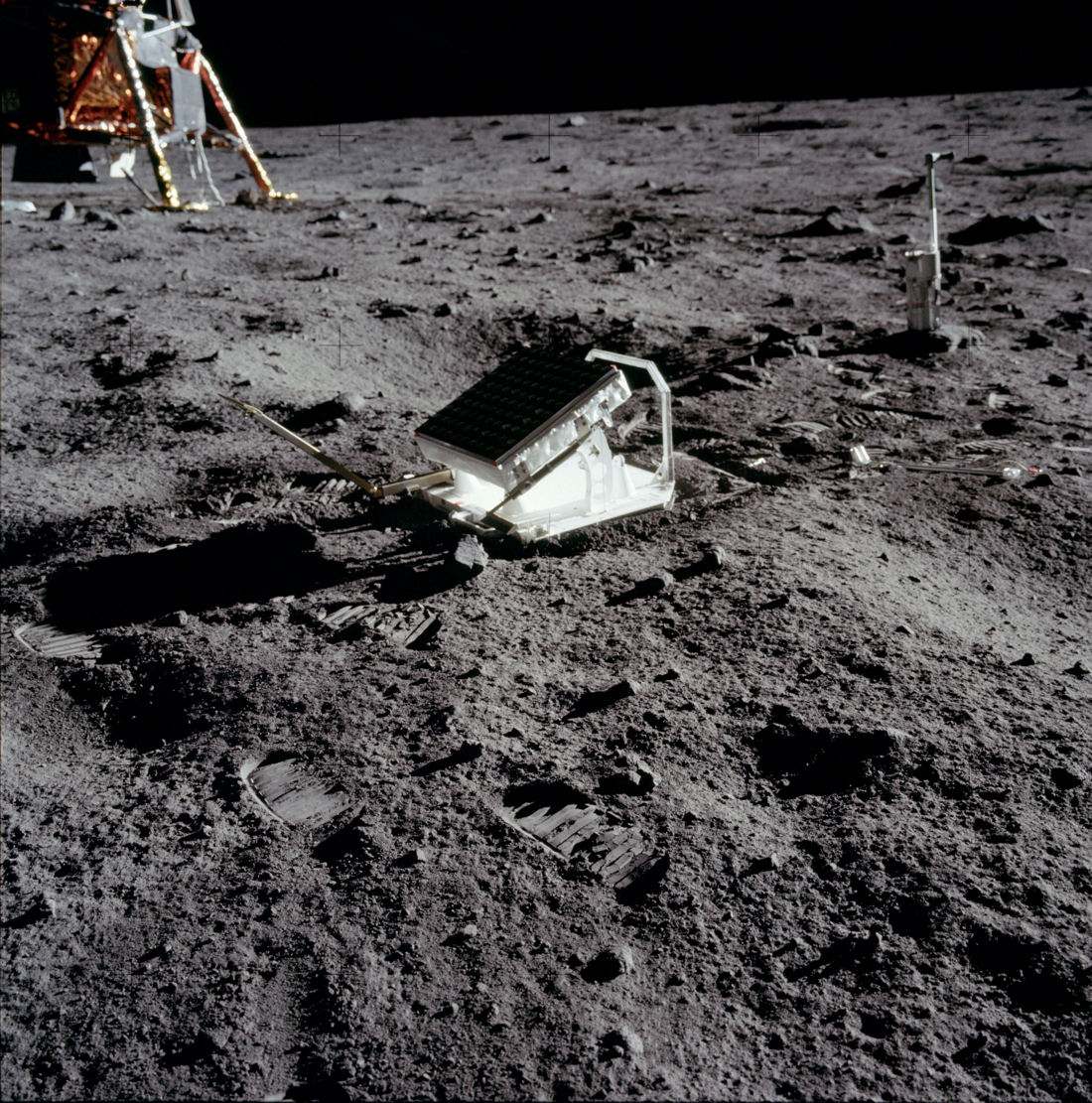
True Believers also claim that what was dubbed the Lunar Laser
Ranging experiment also proves that we really went to the
Moon. As
the
story
goes, the astronauts on Apollo 11, Apollo 14, and Apollo 15
all
allegedly left
small laser targets sitting on the lunar terrain (one of them
can be
seen in
the official NASA photo reproduced below), so that scientists
back home
could
then bounce lasers off the targets to precisely gauge the
distance from
the
Earth to the Moon.
According to the ‘debunkers,’ the
fact that
observatories to this day bounce lasers off the alleged
targets proves
that the
Apollo missions succeeded. It is perfectly obvious though that
the
targets, if there, could have been placed robotically - most
likely by
the Soviets. It is also possible that there are no laser
targets on the
Moon. In December 1966, National
Geographic reported that scientists at MIT had been
achieving
essentially the
same
result for four years by bouncing a laser off the surface of
the Moon.
The New
York Times added that the Soviets had been doing the
same thing
since at
least 1963.
There
was much about the Apollo flights that was truly miraculous,
but
arguably the greatest technological achievement was the design
of the
lunar
modules. Has anyone, by the way, ever really taken a good look
at one
of those
contraptions? I mean a detailed, up-close look? I’m guessing
that the
vast
majority of people have not, but luckily we can quickly remedy
that
situation
because I happen to have some really good, high-resolution
images that
come
directly from the good people at NASA.


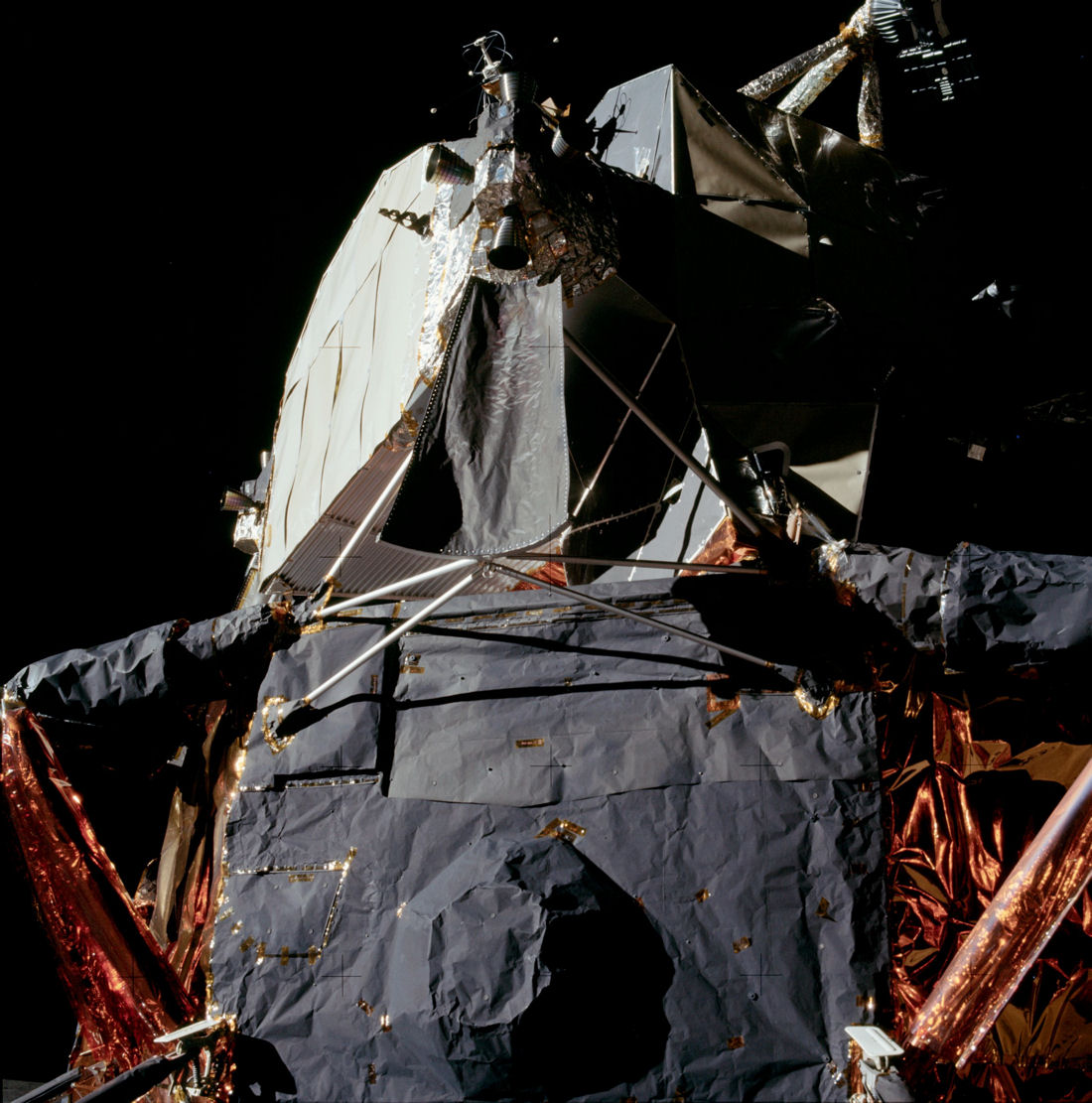
While what is depicted in the images
may
initially
appear, to the untrained eye, to be some kind of mock-up that
someone
cobbled
together in their backyard to make fun of NASA, I can assure
you that
it is
actually an extremely high-tech manned spacecraft capable of
landing on
the
surface of the Moon. And incredibly enough, it was also
capable of
blasting off
from the Moon and flying 69 miles back up into lunar orbit!
Though not
immediately apparent, it is actually a two-stage craft, the
lower half
(the
part that looks like a tubular aluminum framework covered with
Mylar
and old
Christmas wrapping paper) being the descent stage, and
the
upper half
(the part that looks as though it was cobbled together from
old air
conditioning ductwork and is primarily held together, as can
be seen in
the
close-up, with zippers and gold tape) being the ascent
stage.
The upper half, of course, is the more sophisticated portion, being capable of lifting off and flying with enough power to break free of the Moon’s gravity and reach lunar orbit. It also, of course, possessed sophisticated enough navigational capabilities for it to locate, literally out in the middle of fucking nowhere, the command module that it had to dock with in order to get the astronauts safely back to Earth. It also had to catch that command module, which was orbiting the Moon at a leisurely 4,000 miles per hour.
But we’ll get to all that a little
later. I
think we
can all agree for now that such a sleek, stylish,
well-designed
craft would
have no problem flying with that kind of power, precision and
stability.
There is one thing that appears to be
a
problem
though: how did they get everything on board the modules that
they were
going
to need to successfully complete their missions? According to
NASA, the
modules
were (excluding the landing pads) only about twelve feet in
diameter.
That is
obviously not a whole lot of space to work with, so let’s try
to think
of
everything that we would need if we were astronauts venturing
off on a
little
journey to the Moon.
First of all, of course, we have to
account
for the
space taken up by the various components of the ship itself.
There is
the
framework and the, uhh, let’s call it the ‘fuselage’ of the
craft. And
we will
need a lot of very sophisticated navigation and guidance and
communications
equipment, all of which took up a whole lot more space back in
the ‘60s
than it
would today. And then, needless to say, there is the power
supply – or
rather
multiple power supplies. For the descent stage, there is the
reverse-thrust
rocket that allegedly allowed the craft to make a soft landing
on the
Moon. And
then for the ascent stage, there is a powerful rocket to
propel the
random
bundle of sheet metal into lunar orbit. There are also
additional
rockets to
allegedly stabilize the vessel in flight (the random clusters
of what
look like
bicycle horns).

Next up is the massive amount of fuel
that
will be
required to power all of those rockets, for both the ascent
and descent
stages
of the mission. The ascent stage in particular is going to be
a bit of
a fuel
hog, as ascending 69 miles and breaking free of the Moon’s
gravity is a
formidable challenge, to say the least. Though it may only
have 1/6 the
gravitational pull of Earth, keep in mind that it is still a
force
strong
enough to create the tides here on Earth, 234,000 miles away.
I’m not a rocket scientist, by the
way, so I
am sure
that there are quite a few components that I am leaving off of
my lunar
module
– but that’s okay, because our spaceship is already feeling
really
cramped just
with the stuff listed so far. And we’re just getting started.
Next we have to include everything
required
to keep
ourselves alive and well. We aren’t going to be there very
long, of
course, and
space is obviously limited, but we will still require some
basic
amenities. We
will, after all, have to sleep somewhere in the ship, won’t
we? Or will
we just
unfold cots on the lunar surface? We will also require a
sanitation/septic
system of some kind. Or did those missions bring about another
‘first’
that
NASA has been reluctant to brag about? Was Neil Armstrong,
unbeknownst
to the
American people, the first man to take a dump on lunar soil?
Or was it
Buzz
Aldrin? Which astronaut has the distinction of being the first
to soil
the
lunar landscape?
Anyway, getting back to our packing
list, in
addition
to a sanitation system, it is imperative that we bring along
an
adequate supply
of food, water and oxygen – and not just enough to last for
the planned
duration of our visit, but enough to supply a small safety
cushion
should
anything go wrong. Because from what I have heard, running out
of food,
water
or oxygen while on the Moon can really fuck up an otherwise
perfectly
good
trip. The oxygen is especially important, so we’re going to
need a
really good,
reliable system to deliver that oxygen, and to, you know,
recharge the
oxygen
tanks in our spacesuits so we can walk around on the Moon and
jump like
8” or
9” high like the Apollo guys did. And a back-up oxygen system
probably
wouldn’t
be a bad idea.
We are also going to need to install
a
top-of-the-line heating and cooling system. Probably several
of them,
actually.
Because the ‘weather’ on the Moon, so to speak, can be a bit
unpleasant.
According to the experts over at NASA, daytime highs average a
balmy
+260° F,
but it
cools off quite a bit at night, dropping
to an average of -280° F. If you’re looking for
anything between those two extremes, you won’t really find it
on the
Moon. It’s
pretty much one or the other. If you’re in the sun, you’re
going to be
boiled
alive, and if you’re out of the sun, you’re going to be flash
frozen.
I’m not at all sure how the air
conditioning
system
is going to work, come to think of it, since air conditioning
requires
a steady
supply of – and please stop me if I am stating the obvious
here – air.
And the
Moon doesn’t really have a lot of that.
It would help, of course, if our
spacecraft
was
heavily insulated in some manner, but that doesn’t appear to
be the
case, so
we’ll need a really, really good heating and cooling system,
and plenty
of
freon or whatever it is that we’ll need to keep it running. So
now we
have to
add all of the following to our already crowded spacecraft:
ourselves;
a
minimal amount of room to sleep and otherwise take care of the
basic
necessities of life; some type of plumbing and sewage system;
a really
good
heating and cooling system, and a considerable supply of food,
water
and
oxygen. And we’re still not done packing for our trip.
Now we have to add all of the
equipment that
will be
required to maintain the ship and complete our planned
missions. First
of all,
we are definitely going to need to pack an exhaustive supply
of spare
parts and
a wide variety of tools. That is an absolute must. From what I
have
heard,
there are a few stores on the Moon that do stock spaceship
parts, but
they tend
to close on certain days of the week. And orders from the
mainland can
take a
frustratingly long time to arrive, so it’s always best to be
prepared
for any
emergency. There are a lot of things that can go wrong with
our
spaceship and
the only thing harder than finding a good mechanic here on
Earth is
finding one
on the Moon.
And then, of course, we’ll have to
bring all
the
fancy testing equipment that we will use to pretend to conduct
experiments.
Some of it is quite bulky, so we’ll need to set aside some
storage
space for
all of that. And we’re going to need some additional storage
space to
bring
back all those petrified wood samples, but we should have room
for that
after
we jettison most of the fake testing equipment.
Our spaceship is now so ridiculously
overloaded that
we may have had to add a roof-rack and we still aren’t quite
done yet.
We still
have a couple more items to pack, and we probably should have
gotten
them on
sooner because they are going to require a lot of space. Since
this is
one of
the later Apollo flights, you see, we also have to pack a dune
buggy,
otherwise
known as a lunar rover. And the rovers, according to NASA, are
a full
ten feet
long, just two feet less than the diameter of our craft. But
not to
worry –
according to NASA, the rovers (pictured below) folded up
to the
size of a
large suitcase. When released, they would just sort of
magically
unfold
and snap
into place, ready to roam the lunar terrain.

To be perfectly honest, I’m not
really sure
why we
have to pack the damn rover. There is no real compelling
reason to take
it to
the Moon … except for the fact that they make for good TV, and
that
seems to be
of paramount importance. And as can be seen below, it should
easily fit
into
our spaceship.

One last thing we’re going to need is
a whole
lot of
batteries. Lots and lots of batteries. That’s going to be the
only way
to power
the ship while we’re on the Moon, and we’ll definitely need to
run the
communications systems, and the oxygen supply system, and the
heating
and
cooling system, and the cabin lights, and the television
cameras and
transmitters, and all the testing equipment, and our
spacesuits, and
that damn
rover. And we won’t be able to recharge any of the various
batteries,
so we’re
going to need a lot of back-ups. Especially of the really big
batteries
that
run the ship. We may need a separate ship just to carry all
the
batteries we’re
going to need.
By the way, I can’t possibly be the
only one
who is
disappointed that we never followed up on that breakthrough
folding-vehicle
technology. If we had folding Moon buggies back in the early
1970s,
then how
far behind could folding automobiles have been had we chosen
to stay
the
course? Had NASA’s pioneering vision been followed up, we
could all be
folding
up our cars and tucking them away under our office desks. But
as with
all the
Apollo technology, it existed only in that specific period of
time and
has now,
sadly, been lost to the ages.
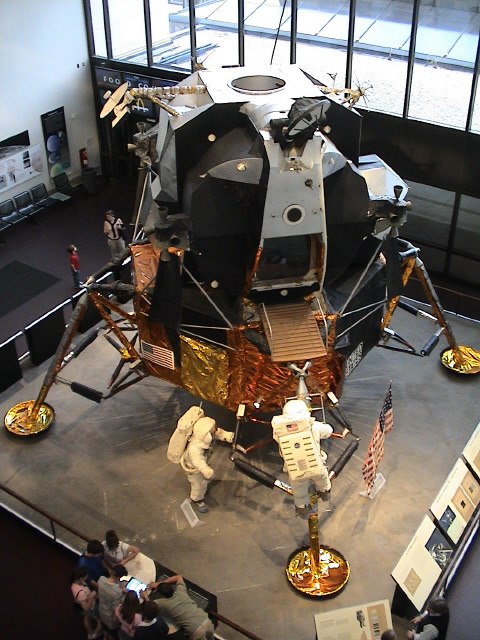
NASA has done something very odd, by
the way,
with
the lunar module that it has on display for museum visitors to
marvel
at: it
has staffed it with miniature astronauts wearing miniature
space suits
(the
module may also be scaled slightly larger than the ‘real’
modules that
allegedly landed on the Moon). I wonder why they would do
that? I’m
pretty sure
that Buzz and Neil were of normal stature, so the only reason
that I
can think
of that they would use miniature astronauts would be to
portray the
modules as
larger than what they actually were. And in better condition
too. Did
they pick
up the ones they sent to the Moon at a used car lot?
Before moving on, I need to emphasize
here
just how
sophisticated the lunar modules actually were. These
remarkable
spacecraft –
and I understandably get a little choked up here talking about
this,
because I
am just so damn proud of our team of Nazi scientists – managed
to make
six
perfect take-offs from the surface of the Moon! And
understand
here
people that they did that, amazingly enough, with
completely
untested technology!
You can’t duplicate the conditions on the Moon here at home, you see, or even provide a rough approximation. And since no one had ever been to the Moon, they didn’t know exactly what to replicate anyway, so this part of the mission was pretty much of a crapshoot. Conditions on the Moon are, to say the least, a bit different than here on Earth. The gravitational pull is only about 1/6 of what it is here. And then there is that whole ‘lack of atmosphere’ thing. And the decidedly unearthly temperatures. And then, of course, there are the high levels of space radiation.
I’m quite sure that we had the best
minds
available
working on the Apollo project, but none of them could have
accurately
predicted
and compensated for how all those unearthly conditions would
combine to
affect
the flight potential of the lunar modules. So the ability of
the
modules to
actually blast off from the Moon and fly was, at best, a
theoretical
concept.
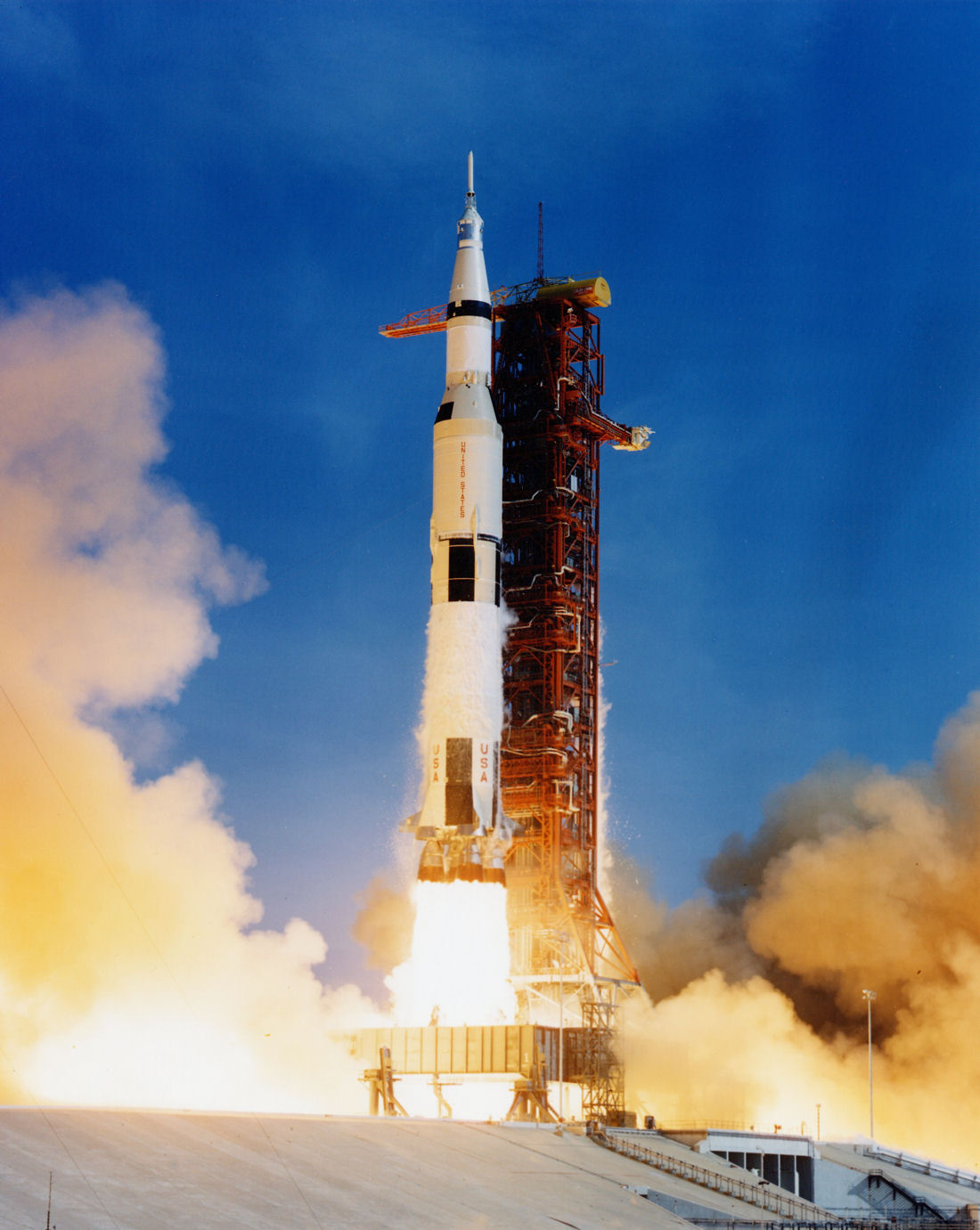
It is also important to remember
that, unlike
the
initial blast-off from Earth (seen above), which involved the
collective
efforts of thousands of people and the use of all types of
peripheral
equipment, the astronauts taking off from the Moon had only
themselves
and a
strange vessel that looked like it had been salvaged from the
set of Lost
in
Space. What would you be thinking, by the way, if you
suddenly
found
yourself on the surface of the Moon with what looked like a
cheap movie
prop as
your only way home? Would you feel comfortable hanging around
for a few
days
doing experiments, confident that, when the time came, the
untested
contraption
behind you would actually get you back home from the Moon? Or
would the
words
“bad career choice” be running through your head?
But as it turns out,
On Earth, it took many long years of
trial
and
error, many failed test flights, many unfortunate accidents,
and many,
many
trips back to the drawing board before we could safely and
reliably
launch men
into low-Earth orbit. But on the Moon? We nailed that shit the
very
first time.
Today, of course, we can’t even
launch a
space
shuttle from right here on planet Earth without occasionally
blowing
one up,
even though we have lowered our sights considerably. After
all, sending
spacecraft into low-Earth orbit is considerably easier than
sending
spacecraft
all the way to the friggin’ Moon and back. It would appear
then that we
can
draw the following conclusion: although technology has
advanced
immeasurably
since the first Apollo Moon landing and we have significantly
downgraded our goals
in space, we can’t come close to matching the kick-ass safety
record we
had in
the Apollo days.
The thing is that, back in the
frontier days,
we
didn’t need all that fancy technology and book-learnin’ to
send Buzz
and the
boys to the Moon and back. Back then, we had that American
can-do
spirit and we
just cowboyed up and MacGyvered those spaceships to the Moon.
All we
needed was
an old Volkswagen engine, some duct tape and a roll of bailing
wire.
Throw a
roll of butt-wipe and a little Tang on board and you were good
to go.
And how about the speed with which we
cranked
out
those Apollo spacecraft? Once we figured out how to make them,
we were
stamping
them out like Coke cans. We fired off seven of them in just
under
three-and-a-half years, or about one every six months. Given
the
extreme
complexity of those vessels, and the fact that every component
had to
perform
flawlessly under largely unknown conditions, that is a pretty
impressive
production schedule.