

Wagging the Moondoggie, Part V
October 1, 2009
by David McGowan
Stars
are not the only thing missing in the Moon photos. Also
conspicuously absent is any indication that the lunar modules
actually
landed
in the locations in which they were photographed.
Specifically, there
is no
crater visible under any of the modules, despite the fact that
NASA’s
own
artist renderings clearly showed the presence of a substantial
crater.
Also,
not a speck of dust appears to have been displaced by the
10,000 lb
reverse-thrust engine that powered the alleged descent.
NASA’s artist renderings also depict
a
considerable
quantity of smoke and flames shooting out from the bottom of
the
modules,
though nothing of the sort is visible in the purported video
footage of
the first
landing
of a lunar module, allegedly shot
from inside the module as it set down on lunar soil. In
addition,
despite the
ridiculously close proximity of the immensely powerful rocket
engine,
no noise
from that engine can be heard on the video.

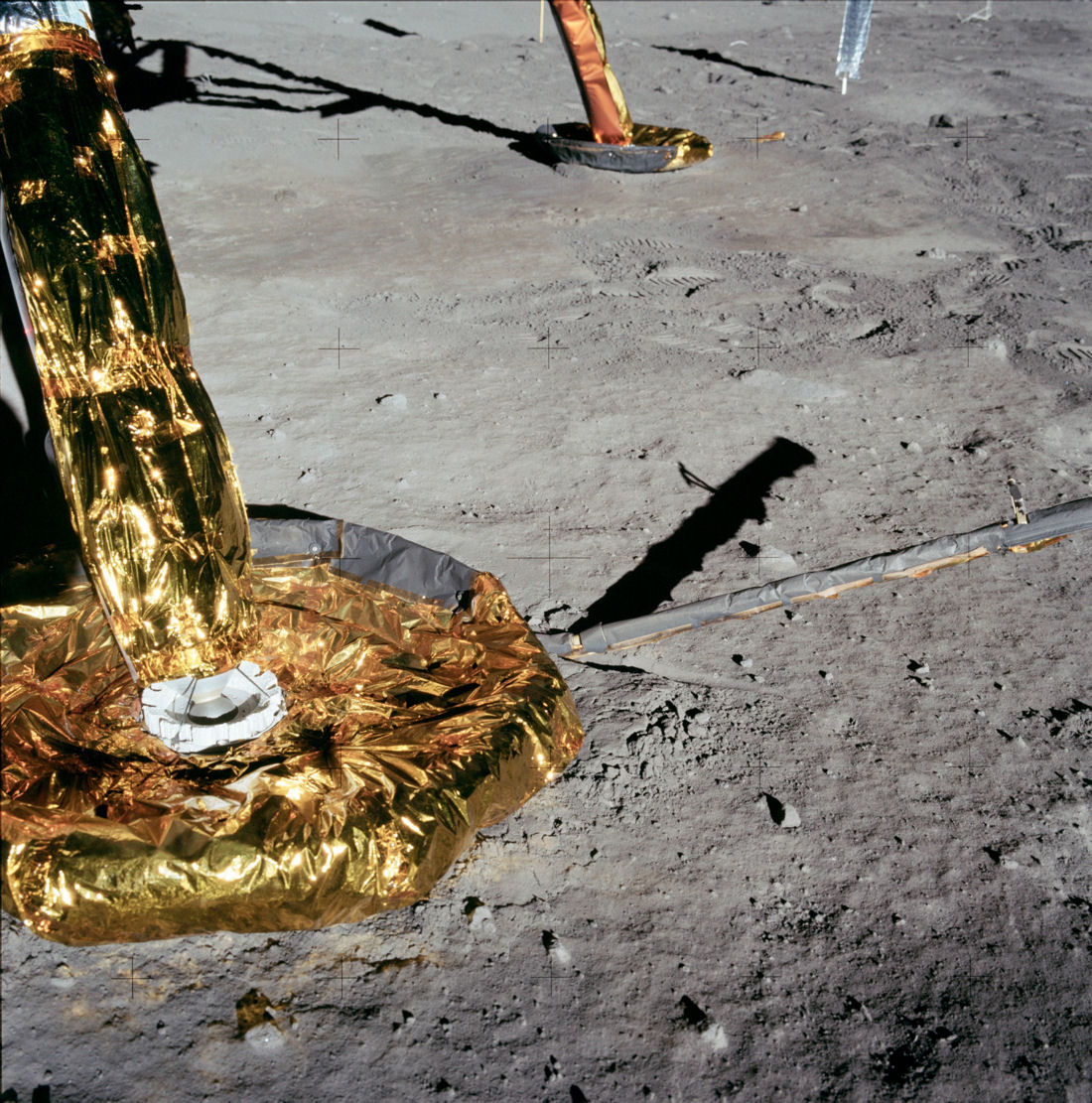
As can be seen in the photo above,
the area
directly
under what is supposed to be the nozzle of the descent stage
engine is
completely undisturbed. Not only is there no crater, there is
no sign
of
scorching and none of the small ‘Moon rocks’ and not a speck
of ‘lunar
soil’
has been displaced! And if you refer back to the earlier
close-up of
the
module’s landing pod, you will see that not so much as a
single grain
of ‘lunar
soil’ settled onto the lunar modules while they were setting
down.
Your initial response to this may
well be,
“Well,
duh! ... why shouldn't the surface of the Moon be
undisturbed?”
Glad you asked. The answer is that
the lunar
modules
were not placed upon the Moon by the hand of God. They had to
actually land
there. And in order for them to land there in one piece, they
had to
make use
of powerful reverse-thrust rockets. If they hadn’t, they would
have
made
landings roughly comparable to a piano falling off the balcony
of a
high-rise
apartment building.
“But,” you say, “isn't the
gravitational pull
of the
Moon considerably less than that of the Earth?” Of course it
is, but
that does
not render objects weightless. A vehicle with a curb weight of
33,000
pounds
here on Earth (what the lunar modules weighed, according to
NASA) still
weighs
close to three tons on the Moon, so it’s not going to make a
very soft
landing
without assistance. And the assistance options were
necessarily limited.
NASA could not have used parachutes,
such as
were
used with the returning command modules, because parachutes
don’t
really work
without air, so that would have been a dead giveaway that the
landings
were
faked. They also couldn’t use a helicopter-type rotor, because
those
also don’t
work in an environment devoid of atmosphere. What they
allegedly used
then to
provide the necessary ‘brakes’ was a powerful, reverse-thrust
rocket
engine.
That is why, in the artist renderings
of the
landings (the landings obviously couldn’t be filmed, because
no one was
supposed to be there yet), an enormous blast of flame and hot
gas is
seen
shooting out of the bottom of the module. This massive reverse
force
would have
served to counteract the effects of the Moon's gravitational
pull,
allowing the
module to gently set down in the lunar dust, unharmed and
intact. And
needless
to say, that is kind of important when that very same vehicle
is your
only ride
home.
The ‘debunkers,’ by the way, like to
pretend
as if
the hoax theorists made those artist renderings up themselves,
as if to
say,
“Hey, look over here! I just made up this drawing of what I
think the
landings should look like and NASA’s landings looked nothing
like my
drawing!”
The reality though is that NASA’s own artists provided those
images,
based on
the way that NASA claimed the modules would perform. What the
‘debunkers’ are
telling you, in other words, is that NASA didn’t really
understand how
their
own technology was supposed to work.
Given the manner in which the modules
allegedly
landed, the problem here is that – unless the landing surface
was paved
with,
say, concrete – an inordinate amount of material should have
been
displaced by
the force of the rocket blast as the module was setting down.
As Plait
likes to
say, you can easily verify this yourself. All you have to do
is get
hold of a rocket
with 10,000 pounds of thrust (there probably are some
surviving members
of the
von Braun clan that can hook you up), and head out to the
nearest
desert
location.
Once you find a suitable spot to
conduct this
experiment, hold the rocket aloft (you might want to wear
gloves and an
asbestos suit for this part, but it’s up to you) and fire that
son-of-a-bitch
up, directing the blast towards the desert floor (it might
also be a
good idea
to grab on to a stationary object with your free hand and hold
on real
tight).
Let it rip for whatever you think would be a reasonable amount
of time
to
complete a landing procedure, and then shut it off.
If you've done this correctly, the
result
will be a
fairly large crater and a blinding dust storm. That dust will,
of
course,
eventually settle, leaving a heavy coating of dust on you and
your
rocket. You
may also notice that the blast has lent the desert floor a
distinctive
scorched
look. If you run the experiment for too long, you may even
find that
the
intense heat has fused the cratered sand into something
resembling a
large bowl
of glass.
The point here, of course, is that
nothing of
the
sort is evident in the pictures allegedly brought back from
the Moon.
The lunar
surface is, as noted, completely undisturbed and the modules
are as
clean as if
they had just rolled off the assembly line. It appears as
though they
did not
land at all, but were rather set in place with a crane or
other such
device.
And of course we all know that there were very few crane
operators on
the Moon
in the late ‘60s and early ‘70s.
How then did the modules get there? Could it be that the lunar surface was so compact that even the considerable force of the rocket could not dislodge it? That might be a credible explanation were it not for the fact that the astronauts themselves, who with the Moon's reduced gravitational pull weighed in at about 30 pounds apiece (maybe 60 pounds each with the additional alleged weight of their packs), made readily identifiable footprints from the moment their feet hit the ground. It appeared, in fact, as though the lunar soil had roughly the same consistency as baby powder. And yet, amazingly enough, not a single grain of this soil seems to have been displaced by the landing of the modules.
The ‘debunkers,’ naturally enough,
have an
explanation for this. According to them, it’s all about
throttle
control. As
Plait explains, “Sure, the rocket on the lander was capable of
10,000
pounds of
thrust, but they had a throttle. They fired the rocket
hard to
deorbit
and slow enough to land on the Moon, but they didn’t need to
thrust
that hard
as they approached the lunar surface; they throttled down to
about 3000
pounds
of thrust.”
Plait also notes that originally on
his site
he had
said “that the engines also cut off early, before the moment
of
touchdown, to
prevent dust from getting blown around and disturbing the
Astronauts’
view of
the surface. This was an incorrect assertion.” The funny thing
is
though that
he voiced that “incorrect assertion” just as forcefully and as
arrogantly as he
voices all the other assertions on his page – which makes
sense, I
guess, since
everything else on his page is incorrect as well.
Phil has obviously never landed a lunar module. Or given much thought to how you would go about doing so. Actually, that’s probably not true. Phil is most likely just a shameless liar. Not a particularly good one, mind you, but you have to remember that he is working with a handicap – he has to weave all of his ‘debunking’ arguments around NASA’s lies.
Let’s try to inject a little sanity
into this
discussion, shall we? First of all, no one with an ounce of
common
sense is
going to cut the engine and let their three-ton spaceship
simply drop
onto the
lunar surface. Nor are they going to cruise on in while
progressively
easing up
on the throttle, effortlessly setting the module down, as
Plait claims,
like “a
car pulls into a parking spot,” as if they had been landing
lunar
modules since
the day they were born. Because the reality is that the six
astronauts
who allegedly
landed the six lunar modules hadn’t done it before and they
only
had one
chance to get it right.
And do you know why, Phil? Because
that
module was
their only ride home, and if they damaged it in any way, they
weren’t
going
home. Ever. They weren’t going to do anything except die
within days in
the
most desolate place imaginable. And that is why it is
perfectly obvious
that,
if they had really gone to the Moon, they would not
under any
circumstances
have landed the modules in either of the ways that Plait has
suggested.
Has anyone ever seen a helicopter
land? That
is
essentially how you would land a lunar module as well. The
basic
technique is
to line yourself up with your landing site while hovering a
fairly
short
distance above the ground (with the module, I presume, you
would hold
your
position by utilizing those clusters of horns). Then, when
you’re
stabilized
and lined up just where you want to be, you very slowly
ease
off the
throttle so as to very gently set it down. And if you’ve never
done it
before,
you’re definitely going to want to take your time.
And that is why there quite obviously
should
be
blast craters under those lunar modules. That is why NASA
itself
indicated that
there would be blast craters under the lunar modules. And that
is also
why it
is fundamentally impossible for the modules to be as
impeccably clean
and
dust-free as they are in all of NASA’s photos. And no amount
of
spinning from
the ‘debunkers’ will ever explain that away.
As
previously mentioned, there was much about the Apollo project
to
stand in awe of. Every individual phase of the missions was,
in and of
itself,
a breathtaking technological achievement. Just blasting men
into Earth
orbit is
a daunting task – so much so that in the nearly half-century
that has
passed since
the first two nations did it (the
And achieving Earth orbit was just
the
beginning.
Then there was the 234,000-mile journey through the unknown to
get to
the Moon
– on a single tank of gas in an unshielded spaceship. Then
there was
the main
ship giving birth to the lunar module, and that untested lunar
module
then
flying down and making a perfect landing on the surface of the
Moon.
Then there
was that same untested lunar module blasting off from the
surface of
the Moon
without the assistance of any ground grew and ascending 69
miles to
attain
lunar orbit. Then there was the ever-reliable lunar module
finding,
catching
and docking with another ship while in lunar orbit, utilizing
yet more
untested technology. Then there was the command module
shedding the
lunar module and then commencing that 234,000-mile journey
back home.
But as remarkable as it was to get
the
astronauts
safely to and from the Moon, their survival while on the Moon
was
equally
remarkable. To say that the Moon is an environment
incompatible with
the
survival of humans would be a considerable understatement –
which
brings us to
our next topic of discussion: those amazing NASA Moonwalking
suits.
Those suits were able to provide the
astronauts with
everything they needed to stay alive in the Moon’s harsh
environment.
Remember
NASA’s elaborate rendering of what a Moon work station
protected from
space
radiation would look like? Neil and Buzz didn’t need any of
that fancy
stuff
because they were wearing the magic suits. And those extreme
temperatures of
+260° F to
-280° F?
Not a problem when
you’re wearing the magic suit. Not only could they provide the
cooling
needed
to combat the searing temperatures in the sun, but they could
also
provide the
heat to counteract those frigid shadows.
As can be seen in NASA’s photos, the
egress
side of
the lunar modules (the side with the ladder and hatch) was
usually in
the shade
(though almost always well lit). What that means is that,
after
traipsing
around in the sun for a spell, the astronauts would have had
to step
into the
shadows to reenter the spacecraft. And when they did so, those
spacesuits were
apparently smart enough to react instantly and switch over
from
turbo-charged
air conditioning to blast-furnace heating in the blink of an
eye.
Awesome!
In addition to providing radiation
protection
that
today’s technology is unable to match, and a climate control
system
that is
beyond anything available in the twenty-first century, the
magic suits
also
provided the astronauts with breathable air, which definitely
came in
handy.
What the suits did, in essence, was provide the astronauts
with their
own
little portable, climate-controlled, radiation-protected
atmosphere.
Of course, to actually do that (if
we’re
pretending
that it could be done at all), the suits would have had to
have been
pressurized. And it is perfectly obvious from all the photos
that the
suits
were not, in fact, pressurized, because if they were, the
astronauts
would have
looked like the Michelin Man bouncing around on the surface of
the Moon.
The magic suits had to perform one
other
function as
well: they had to serve as head-to-toe body armor. Because the
Moon,
according
to NASA, has a serious problem with drive-by shootings from
outer
space.
Seriously. I’m not making that up. I read it on NASA’s own
website.
In the very same NASA post that
discusses
Moon rocks
being constantly bombarded with absurdly high levels of
radiation,
another
curious admission can be found: “meteoroids constantly bombard
the
Moon.” Our
old friend from NASA, David McKay, explains that “Apollo moon
rocks are
peppered with tiny craters from meteoroid impacts.” NASA then
explains
that
that “could only happen to rocks from a planet with little or
no
atmosphere …
like the Moon.”
“Meteoroids,” NASA continues, “are
nearly-microscopic specks of space dust that fly through space
at
speeds often
exceeding 50,000 mph – ten times faster than a speeding
bullet. They
pack a
considerable punch … The tiny space bullets can plow directly
into Moon
rocks,
forming miniature and unmistakable craters.”
According to NASA, every square inch
of every
exposed surface of every rock allegedly gathered from the
surface of
the Moon
shows this pattern. By extension then, we know that every
square inch
of the
lunar surface is peppered with meteoroid craters. There really
is no
safe place
to hang out. There you are minding your own business lining up
your
golf shot,
and the next thing you know a meteoroid is ripping through
your
spacesuit at
50,000 mph. That has to sting a little bit.
Actually, what it would do is kill
you.
Almost
instantaneously. Not the projectile itself, which probably
wouldn’t be
lethal
after passing through the spacesuit, but ripping or puncturing
your
magic suit
while on the Moon is certainly something that you would want
to avoid.
You know
that old saw about how “nature abhors a vacuum”? How that
applies here
is that
any penetration in your suit would result in all the air being
immediately
sucked out. And then your blood would begin to boil. And that
can be
rather
unpleasant.
I guess the Apollo crews really,
uhmm, dodged
a
bullet on that one. Not one of the astronauts was hit, nor any
of the
lunar
modules, nor any of the lunar rovers, nor any of the equipment
that was
used. I
have to say here, by the way, that those Apollo guys were
studs of the
highest
magnitude. Did they know what they were signing up for? What
did NASA’s
ads
say?
“Astronauts wanted. No experience
necessary.
Duties
will include taking a trip to the Moon. Return trip cannot be
guaranteed.
Applicant must be able to withstand levels of radiation higher
than
anything
that can be generated here on Earth. Applicant must also be
able to
work
comfortably in heat in excess of +250° F, as well as in cooler
conditions approaching -300° F. A continuous supply of
breathable air may or may not be provided by employer. Snacks
and water
will
necessarily be limited to what fits in employee-provided
lunchbox. Rest
room
facilities will not be available. The ability to dodge 50,000
MPH space
bullets
is not required, but would be helpful. This is a great
money-making
opportunity! Paychecks can be picked up upon return to Earth.”
The Apollo guys didn’t have to worry
about
any of
that, of course, because they were wearing the magic suits.
Apparently
those
suits were yet another example of NASA digging deep into the
well of
lost 1960s
technology.
A huge shout-out, by the way, is in
order
here for
the guys at NASA for posting that article about the Moon rocks
being
bombarded
with radiation and meteorites. It makes it so much easier for
me when
NASA has
already done so much of the work of debunking the Moon
landings.
When
President George W. Jetson announced on January 14, 2004 that
It’s not, after all, as if we have to
reinvent the
wheel here. Not only have we done this before, but we have
done it
safely and
reliably. How could NASA possibly improve upon the record of
the Apollo
missions? What could they come up with that could outperform
those
vintage
Saturn V rockets that made it to the Moon damn near every
time, and
made it
home safe every time? And how do you improve upon a
lunar
module that
not only performed flawlessly every time, but that was also
the very
model of
lightweight, compact efficiency?
When you have a system that performs
flawlessly on
six incredibly technologically complex missions, and that
delivers your
astronauts home safely even on the one occasion that the
system runs
amok, why
in the world would you toss it in the trash and start from
scratch the
next
time around?
According to a Fox News
report
published the
day after Bush’s announcement, “The effort to return to the
Moon will
require
building new spacecraft and sending out robotic craft to
provide
materials to
be used later by human explorers, say experts.” I wonder why
they would
need to
do that? We didn’t have to do shit like that last time. Why
does NASA
keep
insisting on reinventing the wheel here? Why do they seem to
have
forgotten
that we are old hands at this sort of thing?
Other people have forgotten as well.
Following
Bush’s attempt to wag the Moondoggie, Republican Senator Sam
Brownback
sternly
warned, “You’ve got the Chinese saying they’re interested – we
don’t
want them
to beat us to the moon!” This may seem like a rather bizarre
concern,
until you
realize that not only is China working on developing a Moon
rocket,
they are
also rumored to be close to completing work on a time machine,
which
will allow
them to transport their Moon rocket back to the mid-1960s and
thus beat
America
to the Moon.
On a more serious note, I’m guessing
that
since
Anyway, doesn't it seem just a little
strange
that
experts would now suggest that if we get to work right away,
we might
be able
to land men on the Moon by the year 2020? Isn't that like
saying that
with a
lot of hard work and a little luck, we might be able to
develop a video
game as
technologically advanced as Pong by the year 2025? Or that by
2030, the
scientific community might produce a battery-operated
calculator small
enough
to fit into your pocket?
And do you think that, if we do ‘go
back,’
the voice
actors will be given a better script? Will we be given
something to
replace
Armstrong’s cheesy “One small step” line and Aldrin’s poetic
“magnificent
desolation” line? Have I mentioned, by the way, that Donald
Bowman, who
worked
at the
A NASA statement
released in July of this year contained a rather curious
assertion:
“Conspiracy
theories are always difficult to refute because of the
impossibility of
proving
a negative.” It is not, of course, NASA that is being asked to
prove a
negative, but rather those pesky ‘conspiracy theorists.’ NASA is
merely
being
asked to prove a positive, which should be a relatively easy
task. All
they
have to do is produce some actual evidence, beginning with all
those
reels of
tape containing the telemetry data, the biomedical data, all
voice
communications, and all the original videotape. They could also
release
the
plans and specifications for all that fancy space hardware. And
maybe
offer
some kind of reasonable explanation for why so many of the
official
photographs
are demonstrably fraudulent.
Alternatively, they could just send
some guys
back
there, to prove that it can be done. It’s been thirty-seven
years and
counting
since the last guests on the Moon checked out. NASA allegedly
filmed
that final
lift-off from the Moon, by the way. In case you haven’t seen
the
historic film
footage, you can view it here. It’s
a very short clip and it’s actually quite funny, so be sure to
check it
out.
I can’t be 100% certain of this, of
course,
but I
have a very strong hunch that NASA picked up the footage off
the
cutting-room floor
after Ed Wood had finished editing Plan 9 From Outer Space.
Actually, I
probably shouldn’t joke about the clip because I do feel kind
of bad
for the
guy that they had to leave behind to operate the camera. I
wonder how
he’s
doing these days?
Actually, NASA claims that the camera
was
mounted on
the abandoned lunar rover (even in space, Americans are
arrogant
litterbugs),
and that the pan and zoom functions were operated remotely by
the
ground crew
back on Earth. You couldn’t control your television from
across the
living room
in those days, but NASA could pan and zoom a camera from
234,000 miles
away.
Awesome! And there apparently either wasn’t any delay in the
signal or
NASA had
the foresight to hire a remote camera operator who was able to
see a
few seconds
into the future.
You really have to hand it to the
NASA boys –
those
guys think of everything.
George W. Jetson’s visionary proposal
envisioned the
Moon as a steppingstone for manned travel to Mars. How that
works
though is a
bit of a mystery to me. The distance between the Earth and
Mars varies
depending upon where the planets are in their respective
orbits, but
the
minimum distance astronauts would have to travel to reach Mars
from
Earth is
36,000,000 miles. And the minimum distance astronauts would
have to
travel to
reach Mars from the Moon is, uhmm, also 36,000,000 miles. So I
guess
what I’m
wondering is: what exactly would be gained by making a pit
stop on the
Moon?
Are there gas stations there to fill
up the
tank?
Some nice hotels maybe where the astronauts could get some
R&R? A
couple of
hot space hookers? How would making a technologically complex
landing
on the
Moon, followed by a lift-off that would require an excessive
amount of
additional fuel, help get our boys to Mars?
Let’s take a big bite out of the
reality
sandwich
here, shall we? The human animal is quite simply not equipped
for space
travel
beyond low-Earth orbit. There is virtually no chance that we
are going
to send men to the Moon anytime soon. Despite what NASA would
like you
to
believe, the
combination of lethal space radiation, lethal temperatures, a
complete
lack of
breathable air, and a lower gravitational attraction that
produces
serious
health problems, including rapid tissue and bone degeneration,
is
simply not
compatible with human existence. Neither is getting pelted
with “space
bullets.”Neither is a lack of food and water.
And as for Mars? A roundtrip ticket
there
would earn
you about 75,000,000 frequent flyer miles. I wouldn’t count on
that
happening
anytime soon.
Astronaut Steve Lindsey, after being
chosen
to
command the final planned mission of the space shuttle, had
this to
say:
“Everybody at NASA feels the same way. We’re in favor of
taking the
next step
and getting out of low-Earth orbit.” So while technology in
every other
realm
of human existence continues to take giant strides forward,
everyone at
NASA
appears to want to take a big step backwards. To 1969.
Before bidding adieu, I have one
final note
to add:
a certain Dr. Thomas Gold was an early skeptic of the
feasibility of
landing on
the Moon. He made headlines prior to the alleged flight of
Apollo 11
when he
predicted that any attempt at a Moon landing would be
disastrous. NASA,
of
course, purportedly proved the good doctor wrong.
Longtime
readers will remember that Dr. Gold was America’s most
prominent
proponent of
the abiotic theory of oil and gas production, and that he went
and
dropped dead
just before the ‘Peak Oil’ propaganda started to heat up. Dr.
Gold was
recently
proven
to
be correct on the origins of
so-called ‘fossil fuels.’ The article, curiously enough,
refers to the
research
as “revolutionary” – which it is, I suppose, if you ignore the
fact
that the
Soviets and Ukrainians did the same research and drew the same
conclusions some
fifty years ago.
We all know that that can’t be true,
however,
because it would be impossible to keep a secret of that
magnitude from
the
entire Western world … right?