

Wagging the Moondoggie, Part X
December 7, 2009
by David McGowan
“The mission of Apollo 8, quite apart
from
its
significant scientific meaning, stimulated an immense
rejuvenation of
the
spirit of mankind, and that spirit needed rejuvenation. A year
featured
by two
grim assassinations [MLK and RFK], by riots, by racial and
social
strife, and a
baffling attempt to end the war left men with a dull sense of
frustration. Then
at the end of such a year came the Apollo 8, an incredible
adventure.”
Dr. Norman Vincent Peale, 33° Scottish Rite Freemason
Apollo
8 was the last Apollo flight to leave the ground during the
Johnson administration. A decade before the launch, LBJ had
laid out
I thought it was global warming that
was
supposed to
be causing most of that, but I guess that is a bit off-topic.
To anyone paying close attention in the 1960s, the ridiculously improbable flight of Apollo 8 should have sent a clear signal that the Apollo Moon missions were going to be seriously lacking in credibility. Launched on the winter solstice of 1968, Apollo 8 was only the third launch of a Saturn V rocket, and the first to carry a crew. The first two Saturn V launches, Apollo 4 and Apollo 6, were what NASA referred to as “all-up” tests of the three-stage launch vehicle. Those tests didn’t go so well.
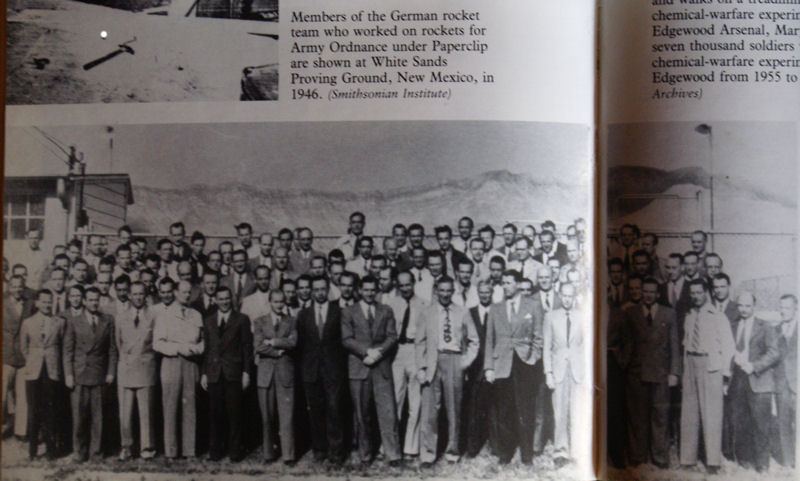
The team of rocket scientists who had
developed the
F-1 and J-2 rocket engines that powered the flights – most of
whom were
former
Nazis recruited through Project Paperclip and relocated first
to White
Sands
and then to the Marshall Space Flight Center in Huntsville,
Alabama
(one of the
best sources of information on this is Linda Hunt’s Secret
Agenda,
St.
Martin’s Press, 1991; see also Tom Bower’s The Paperclip
Conspiracy,
Little, Brown, 1987) – had assumed that each stage of the
craft would
be tested
separately. They were reportedly horrified to find that NASA
was
bypassing such
tests and proceeding directly to an ‘all-up’ test of Apollo 4
– but
probably
not nearly as horrified as the American people would have been
had they
known
the truth about the past lives of NASA’s rocket scientists.
Nevertheless, the launch of Apollo 4,
the
very first
Saturn V launch, was allegedly a smashing success. That claim
seems
rather
dubious, however, given that the next all-up test, of Apollo
6, was
marked by
multiple malfunctions. The first-stage burn had serious
vibration
problems, and
two of the second-stage’s five engines cut out, throwing the
ship
seriously off
course.
According to Moon Machines,
NASA was
undeterred
by the serious problems encountered during the flight of
Apollo 6:
“Despite the
near loss of Apollo 6, NASA was pushing ahead with Apollo 8,
the third
flight
of the Saturn V and the first to carry a crew.” NASA was so
confident,
in fact,
that they decided to throw caution to the wind and swing for
the fence
with
Apollo 8: “The third flight of the Saturn V would carry
astronauts not
to orbit
the Earth, as everyone had expected, but to orbit the Moon.”
Had the Apollo program been a real
space
exploration
endeavor, the first manned flight of the Saturn V would
obviously have
gone no
further than low-Earth orbit, as had been planned. This would
likely
have been
followed by an unmanned flight to the Moon, and then possibly
a flight
‘piloted’ by a dog or some other such mammalian life form. But
taking
logical,
methodical steps toward achieving goals in space was for those
pussies
over in
Without taking any of the preliminary
steps,
and
with a launch vehicle that had failed on its last outing, and
without
knowing
if the ship itself could make the journey there and back,
Not to worry though: NASA was
confident that
all the
problems with Apollo 6 had been diagnosed and fixed, and in
record
time.
Despite the fact that the failed stages of the aircraft
weren’t
available for
inspection, NASA’s crack team was able to expertly pinpoint
and correct
all the
deficiencies so thoroughly that the new and improved Saturn V
rocket
didn’t
even need a test flight to be sure it was working correctly.
Indeed, it
was
ready to go all the way to the Moon!
Given
The
Once NASA’s engineers turned their
attention
to the
Moon as a target of unmanned space flights, ‘disappointment’
continued
to be
the operative word. Beginning in August of 1961, the
Finally, on July 31, 1964, nearly
three full
years
after the first launch, Ranger 7 successfully impacted and
photographed
the
Moon. Rangers 8 and 9 followed in February and March of 1965.
The three
successful probes gathered a combined total of roughly 17,000
images,
which
didn’t change the fact that the Ranger program overall had a
67%
failure rate.
The next year, NASA launched two new
lunar
reconnaissance
programs: Surveyor and the Lunar Orbiter Program. The first
Surveyor
blasted
off on May 30, 1966, with six more to follow, the last on
January 7,
1968. The
goal of the program was to attempt ‘soft landings’ on the
lunar
surface. Two of
the missions, Surveyor 2 and Surveyor 4, crashed, leaving the
program
with
roughly a 29% failure rate. The Surveyor and Ranger programs
had a
combined
failure rate of 50%.
NASA had much better luck with the Lunar Orbiter Program, which involved putting five satellites into lunar orbit between August of 1966 and August of 1967. Each of the five orbited the Moon, capturing high-resolution images, for an average of ten days each. In addition to mapping the lunar surface, the Orbiters also sent back the first images of Earth from space and the first photos of the Earth rising over the lunar horizon. In all, some 3,000 images were beamed back – officially at least.
The problem here, of course, is that
NASA’s
numbers
don’t seem to add up. Does it make any sense at all that the
three
successful
Ranger missions, which flew directly to the Moon and
immediately
crashed, sent
back 17,000 images, and yet the five Orbiters, which spent a
combined
total of
fifty-three days orbiting the Moon, sent back just
3,000
images? That’s
a capture rate of just over two images per hour. And the
Orbiters had
multiple
cameras on board.
There is little doubt that the
Orbiters
returned far
more images than claimed, of which only a select few
(relatively
speaking) were
released. What then happened to the rest of them? I’m going to
go way
out on a
limb here and guess that NASA needed those images for another,
more
important
project: faking the Apollo Moon landings. All of those
glorious shots
of Earth
from space, and of Earth-rises, and of superimposed spacecraft
in lunar
orbit
were undoubtedly created from unreleased imagery captured by
the
Orbiters. As
were, no doubt, the fake lunar sets and the fake lunar
backdrops.
One final note on the Lunar Orbiters:
during
their
flights to and around the Moon, the five satellites recorded
twenty-two
“micrometeoroid events.” The eight lunar modules that made the
trip to
the Moon
apparently recorded no such events. Or maybe the guys just put
some
duct tape
over the holes.
Meanwhile, NASA’s manned space
programs were
having
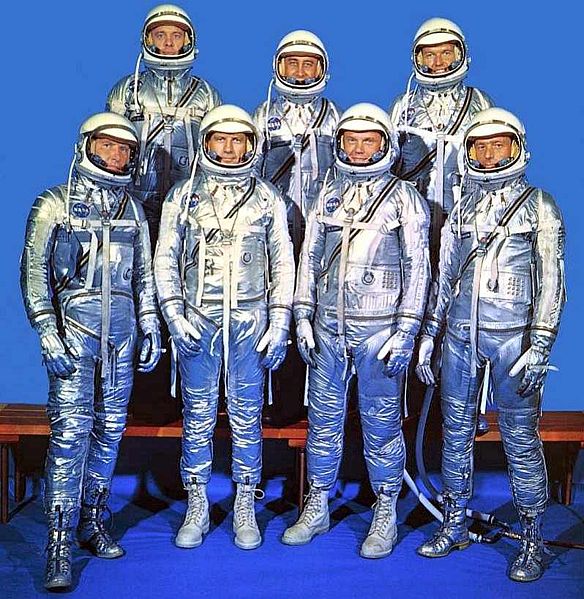
trouble as well. In the beginning, of course, there were the
Mercury 7,
the
nation’s first space-age celebrities. Immortalized in The
Right
Stuff,
the first seven astronauts were hand-picked from among
hundreds of the
nation’s
finest fighter pilots. Six of those seven – Alan Shepard, Gus
Grissom,
John
Glenn, Scott Carpenter, Wally Schirra, and Gordo Cooper –
would become
the
first Americans in space, but for most of them it would not be
an
entirely
smooth ride.
Shepard was the first to take flight
aboard
the
Freedom 7, launched on May 5, 1961. His was an uneventful,
15-minute
sub-orbital flight. Grissom followed on July 21, 1961 in the
Liberty
Bell 7,
and things didn’t go so well for him. As with Shepard, his was
just a
sub-orbital flight, but it nearly cost him his life.
Immediately after
splashing down, the hatch blew on his capsule and it began
taking on
water.
Grissom got free, but his suit, which was supposed to serve as
a
floatation
device, also began taking on water, pulling him under.
Grissom’s plight did not improve with
the
arrival of
a rescue helicopter, which concentrated exclusively on trying
to save
the
capsule, ignoring the struggling Grissom who now also had to
contend
with the
helicopter’s rotor wash. Grissom was pulled to safety only
when a
second rescue
helicopter arrived. The capsule sunk to the bottom of the sea,
three
miles
below.
Glenn was up next, and he was slated
to be
the first
American in orbit. Riding aboard the Friendship 7, launched on
February
20,
1962, Glenn did indeed make it into orbit, but NASA was not at
all sure
that
they were going to be able to get him back. The launch had
been delayed
for a
month as NASA worked out various problems, but there was still
a
serious
glitch: during Glenn’s second orbit, technicians on the ground
determined that
the heat shield, essential for reentry, had come loose.
Glenn’s capsule was seriously damaged
during
reentry, but he survived unharmed and became an instant
national hero.
Next up was Carpenter, who orbited
the Earth
three
times aboard the
Schirra was up to bat next, and he
blasted
off on
October 3, 1962 aboard the Sigma 7, completing six orbits in
just over
nine
hours. His was the first flight since Shepard’s, and the first
orbital
flight,
to be free of any significant malfunctions.
The final Mercury flight was helmed
by
Cooper, who
lifted off on May 15, 1963 inside the Faith 7 capsule. Cooper
completed
22
orbits and was the first American to sleep in space. Problems
arose in
the
final hours, however, when the capsule’s automatic controls
failed and
Cooper
had to execute the first fully manual reentry. It would be
nearly two
years
before the next Americans followed Cooper into space.
Overall, the Mercury program was
largely a
success
in the sense that everyone made it back alive and well, but
Next up was the Gemini program,
featuring a
larger,
two-man capsule. Gemini, which ran from March of 1965 until
November of
1966,
had very specific goals: testing man’s ability to survive in
space for
up to
two weeks; testing rendezvous and docking procedures;
performing EVAs
(space-walks); and making orbital adjustments. All of these
were to be
practiced until they became almost second nature.
The Gemini capsules were launched
into orbit
with
Titan rockets, which proved to be a bit unstable at first. The
first
launch
attempts blew up on the pad. Eventually NASA successfully
launched two
that
didn’t blow up, and those were christened Gemini 1 and Gemini
2. Those
were followed
by ten manned Gemini flights, beginning with Gemini 3 launched
on March
23,
1965, and concluding with Gemini 12, which took flight on
November 11,
1966.
The flight of Gemini 3 was a short
one –
completing
three orbits in just under five hours. Due to an equipment
malfunction,
pilots
Gus Grissom and John Young had to manually control their
reentry and
splashed
down some sixty miles off target. Other than that, the first
manned
Gemini
mission was successful. Gemini 4, launched on June 3, 1965,
remained in
orbit
for just over four days and featured the alleged space-walk by
Ed White
(NASA’s
photos of which are, needless to say, spectacular).

After a successful lift-off on August
21,
1965,
Gemini 5 remained in low-Earth orbit for nearly eight days,
completing
120
orbits. The flight was largely successful, though a
malfunctioning fuel
cell
and faulty thrusters did cause some problems for the crew.
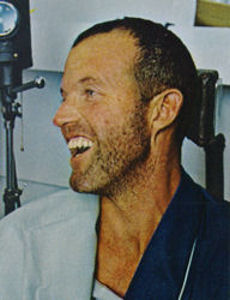
Upon their return, it should be
noted, the
Gemini
5’s pilots, Gordo Cooper and Pete Conrad, looked tired,
haggard and
unshaven,
with their hair greasy and matted. In other words, they looked
exactly
as you
would expect guys who had just spent a week in a cramped
spaceship with
no
means of attending to basic matters of hygiene to look. Below,
left to
right,
are photos of Conrad after returning from his eight-day
mission, Lovell
after
returning from a four-day mission aboard Gemini 12, and Lovell
again
toward the
end of his fourteen-day flight on Gemini 7.
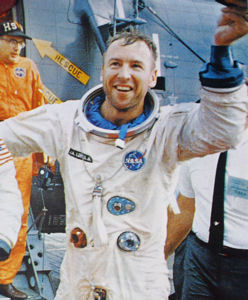

The Apollo astronauts, on the other
hand, all
arrived home looking rested, shaved and fresh faced, as though
they had
just
returned from a day at the spa. Apparently they found room to
include a
shower
and various other amenities on those Apollo spacecraft.

The next scheduled launch was Gemini
6, set
to take
flight in late October of 1965. The flight was postponed,
however, due
to the
failure of an unmanned Agena craft launched as a docking
target. On
December 4,
Gemini 7, with Frank Borman and Jim Lovell on board, began a
grueling
fourteen-day stay in low-Earth orbit. About a week later,
Gemini 6 was
once
again ready for launch, but that launch was aborted when an
engine shut
down,
narrowly averting a fatal explosion on the pad.
Gemini 6 finally got into low-Earth
orbit on
December 11 and remained there for just over one day. During
that time,
Gemini
6 allegedly performed a rendezvous maneuver with Gemini 7, the
two
spacecraft
remaining side-by-side for some 5.5 hours while traveling at
17,000
miles per
hour. Curiously, there was a launch of a military rocket in
between the
launches of Gemini 6 and Gemini 7, and Lovell has said that
that launch
was
connected in some unspecified manner to the mission of Gemini
7.
Gemini 8, helmed by Neil Armstrong
and David
Scott,
blasted off on March 16, 1966. The goal of the mission was to
test
rendezvous
and docking procedures and to achieve the first successful
docking
between a
Gemini capsule and an unmanned Agena craft. Curiously, the two
pilots
chosen
for this complex mission were both rookies. The crew that had
originally been
slated to fly the mission, Elliot See and Charles Bassett,
were killed
on
February 28, 1966, just days before the launch, when See, one
of the
nation’s
top pilots, slammed a T-38 Talon into the side of a building
in
Gemini 8 reportedly succeeded in
docking with
the
Agena target, but trouble began almost immediately. The
conjoined
spacecraft
began to tumble violently end-over-end, forcing Armstrong to
jettison
the
Agena. That, however, only caused the Gemini capsule to tumble
even
more
violently. Armstrong finally had to resort to firing the
rockets used
for
reentry positioning to stabilize the craft, which necessitated
immediately
aborting the mission. The capsule splashed down in the
Pacific, a
half-a-world
away from its target in the
On June 3, 1966, Gemini 9, piloted by
Tom
Stafford
and Gene Cernan, took flight. The launch had been postponed
due to the
failure
of another Agena target. The goal was, once again, to dock
with an
unmanned Agena
craft. That docking failed to materialize, however, when yet
another
Agena
target malfunctioned. This was also the flight on which Cernan
took his
nearly
fatal space-walk (there was debate on the ground over whether
he should
be cut
loose to drift in space or left tethered to burn up upon
reentry if he
couldn’t
make it back in).
Following Gemini 9, there were only
three
manned
Gemini missions left and the United States had thus far failed
to come
anywhere
close to mastering either docking procedures or EVAs, both of
which
would be
absolutely essential for the success of the proposed Apollo
missions.
Gemini 10, with John Young and
Michael
Collins at
the wheel, lifted off on July 18, 1966 and remained in orbit
for just
under
three days. Young and Collins reportedly achieved the first
successful,
stable
docking of a Gemini capsule with an Agena target. Collins also
performed a
largely unsuccessful EVA, though not as disastrous as Cernan’s
on the
previous
flight.
Gemini 11, piloted by Charles Conrad
and
Richard
Gordon, took to the skies on September 12, 1966 and, like
Gemini 10,
remained
in orbit for just under three days. And like Gemini 10, the
mission
included a
docking maneuver with an Agena target and a less than fully
successful
space-walk (by Gordon).
The final Gemini mission, Gemini 12,
put Jim
Lovell
and Buzz Aldrin into low-Earth orbit for just under four days.
Aldrin
completed
the first fully successful space-walk and the two pilots once
again
practiced
docking with an Agena target. NASA had come a long way since
shooting
Alan
Shepard out of a cannon in May of 1961, but the Moon still
seemed like
a
far-off goal. The progression from Mercury to Gemini – from a
single-occupancy
capsule to a somewhat more sophisticated, double-occupancy
capsule,
requiring a
somewhat larger launch vehicle – was a natural one. NASA’s
next step,
however,
was going to be more of a quantum leap.
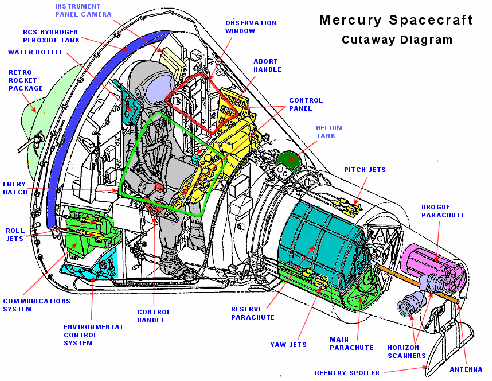

The Saturn V rocket bore little
resemblance
to any
previous launch vehicles. As Apollo flight director Gene Kranz
observed, “It
was a new spacecraft. It was something that we had to learn
from the
ground up
– that we had to learn from scratch.” It was a massive, and
massively
complex,
spacecraft. The Saturn V was so much larger than its
predecessors that
all
previous manned launch vehicles – the six Mercury and ten
Gemini
vehicles –
could fit inside a single Saturn V casing.
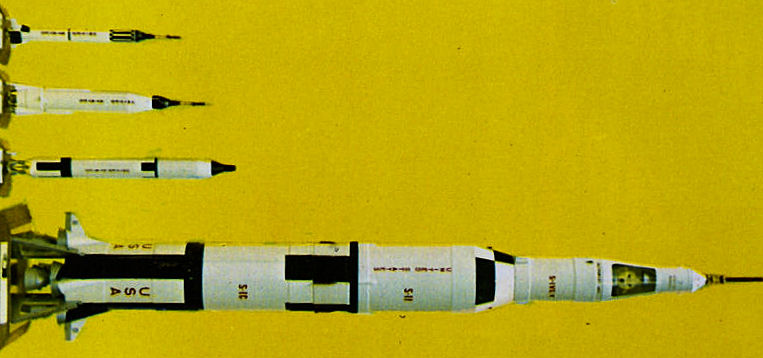
A fully assembled, launch-ready
Saturn V
stood 363
feet tall and weighed in at roughly 6,000,000 pounds, 90% of
which was
fuel
weight. Depending upon who is telling the story, it contained
either
6,000,000
or 9,000,000 parts. There were three disposable launch stages,
atop
which sat
the lunar, service and command modules, which was then capped
with a
launch
escape system that was jettisoned shortly after lift-off.
The 138-foot tall first stage
featured five
massive
F-1 rocket engines, each of which consumed three tons of fuel
per
second. They
were fed by a 331,000-gallon tank of liquid oxygen and a
203,000-gallon
tank of
refined kerosene, all of which was consumed in just
two-and-a-half
minutes,
generating some 7,500,000 pounds of thrust (160,000,000
horsepower).
After that first stage fell away, at
an
altitude of
approximately thirty-five miles, the 82-foot long second
stage, powered
by five
J-2 rocket engines, took over. The J-2s burned a combination
of liquid
oxygen
and liquid hydrogen, propelling the ship to an altitude of 115
miles.
After the
second stage dropped away, the 61-foot long third stage,
powered by a
single J-2
engine, took over, putting the spacecraft into low-Earth
orbit.
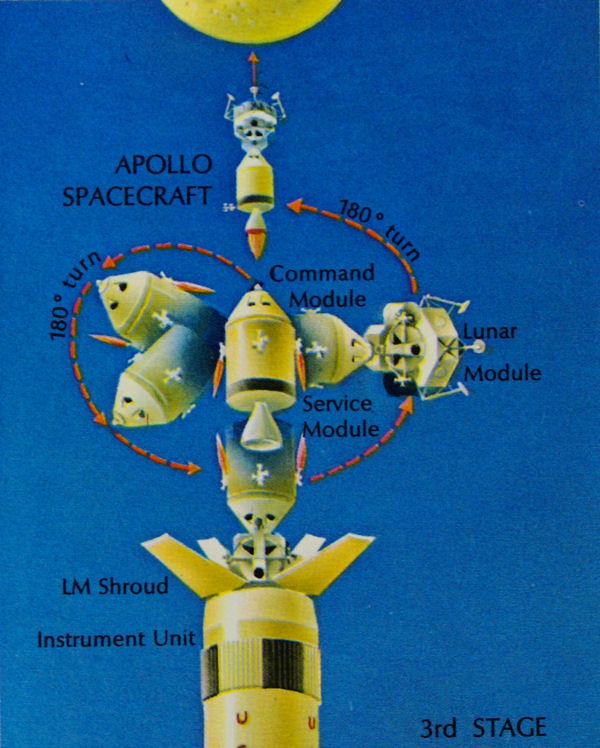
As Time-Life noted, the third
stage
“will not
be jettisoned at this time; instead, three hours later it will
be
restarted to
fire the Apollo toward the moon. At 10,350 miles from Earth,
the
command
module, powered by its service module, will separate from the
third
stage, make
a half-circle turn back toward the third stage, as the lunar
module
shroud of
the third stage opens. The command module will dock with the
lunar
module,
which is to ferry the astronauts between the command module
and the
moon, then
back it free of the third stage. After completing another
half-circle
turn, the
two modules, nose to nose, will head toward the moon.”
Sounds easy enough. I can see why
they were
able to
nail it every single time, unlike the problems they had with
those
troublesome
Agena craft. Time-Life also fills us in on the details
of the
“probe and
drogue” docking mechanism: “The probe, a 10-inch cylinder
extending
from the
nose of the command module, must be inserted into a
cone-shaped
receptacle, the
drogue of the LM … As the probe finds its mark, automatic
spring
latches lock
the two together. The whole probe-and-drogue assembly will be
removed,
clearing
the tunnel through which [the astronauts] will enter the LM.
Inside the
command
module, [the command module pilot] flips a switch that frees
the LM.”
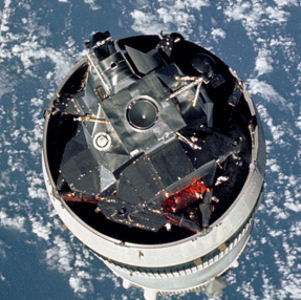
Pictured below are the command
module’s
docking
probe, the LEM’s drogue (with the LEM allegedly in Earth orbit
on the
alleged
Apollo 9 mission, in yet another spectacular shot from NASA’s
collection), and
a close up of how the mechanism was supposed to work.
Curiously left
unexplained was how, with the probe-and-drogue assembly having
been
removed,
the LEM was able to dock with the command module the
second time,
upon
its return from the lunar surface.

I am sure though that the pud-pullers
over at
the BAUT
forum will be able to explain it. Maybe they
can also explain why it is that the space shuttle never went
to the
Moon. I was
thinking about that the other day as I was reading another
heaping pile
of
‘debunker’ blather about how, once you’re into low-Earth
orbit, 90% of
the work
of getting to the Moon is already done.
The ‘debunkers,’ you see, claim that
comparing the
distance astronauts travel into space today (200 miles) with
the
distance they
traveled back in the magical 1960s (234,000 miles) is entirely
unfair
because
it is, as any fool knows, during that first 200 miles that all
the
heavy
lifting is done. Once you’re in low-Earth orbit, it is a
fairly easy
matter to
briefly fire the engines and ‘slingshot’ out of orbit and set
a course
for the
Moon. And getting back is just as easy – just ‘slingshot’
around the
Moon and
cruise on back to Earth. It hardly even requires any fuel.
It’s just a
matter
of, you know, falling through the void of space.
If that is the case, however, then
how come
none of
the space shuttles, during the more than a quarter-century
that the
program has
been in operation, has ever done a fly-by of the Moon? The
Apollo 13
crew
allegedly made the flight in a lunar module composed of
Popsicle sticks
and
Scotch tape, and yet the obviously vastly more sophisticated
space
shuttle
can’t make it there and back? Really?!
Why couldn’t it, on any one of its
missions,
have
just used the old ‘slingshot’ approach to go to the Moon and
back? And
please,
let’s not trot out the old “there was no reason to do that as
there was
nothing
to gain” excuse, because that is clearly a complete load of
horseshit.
The
space shuttle is far better shielded than the Apollo craft
were, it
carries
plenty of fuel and plenty of provisions to last for the
duration of the
trip.
Indeed, today’s astronauts should be able to travel to the
Moon and
back in
relative comfort.
So why has it never been done? Apollo
8 did
it all
the back in 1968, which I started to talk about at the top of
this
post, before
getting hopelessly sidetracked. More on that next time.