
Wagging the Moondoggie, Part XII
February 23, 2010
by David McGowan
“As launch windows open and close,
the
next missions move
forward. Two test flights of the lunar landing vehicle, and
then the
proposed
landing on the Moon. And plans are in the making now which
include
fly-bys of
other planets; visits to what Dr. Bunche calls neighbors.”
From Debrief: Apollo 8, a
NASA
promotional
film circa 1968
Just a few weeks ago, NASA
Administrator
Charlie
Bolden boldly unveiled the agency’s new vision: “Imagine trips
to Mars
that
take weeks instead of nearly a year, people fanning out across
the
inner solar
system, exploring the moon, asteroids and Mars nearly
simultaneously in
a
steady stream of firsts.” (“Launching a Broader Vision for
NASA,”
Yeah, and then imagine visiting a
distant
moon populated
by ten-foot-tall blue people, which is slightly more plausible
than
NASA’s
grandiose dreams.
Bolden’s ambitious proclamation was
intended
to put
a positive spin on NASA’s acknowledgment that the
Constellation
Program, which
President George W. Jetson had promised was going to put us
back on the
Moon by
2020, was being canceled. I’m sure we would have made it
though were it
not for
the fact that President Blackbush doesn’t seem to want to fund
the
effort.
Sure, he increased the agency’s budget for 2011, but he
didn’t, you
know,
increase it enough. So the Constellation Program,
which
taxpayers have
already reportedly shelled out at least $9,000,000,000 for,
and which
will
reportedly cost another $2,500,000,000 to cancel, has been
tossed on
the scrap
heap.
According to Bolden, things weren’t
really
going all
that well anyway: “Currently, [Bolden] said, the 5-year-old
Constellation
program is burning through billions of dollars and falling
further
behind
schedule. The program couldn’t get American astronauts back to
the moon
until
at least 2028 … ‘So as much as we would not like it to be the
case …
the truth
is that we were not on a path to get back to the moon’s
surface,’
Bolden said.”
Well, were we at least on a path to
put
together a
better simulation of landing on the Moon?
Taking into account that the
Constellation
Program
was begun in 2005, and that the Apollo program allegedly
landed men on
the Moon
in a mere eight years, it would appear that it wouldn’t
actually take
twice as
long to get back to the Moon with today’s technology, as
previously
advertised,
but would actually take at least three times as long!
If, that
is, we
were able to man-up and follow through with the plan, which
obviously
isn’t
going to happen.
But be assured that that’s only
because we
don’t
have the money. Otherwise, we totally would have made it back
to the
Moon.
Possibly in less than twenty years. By which time all the
technology
that we
know and love today will be as obsolete as pagers and Betamax
video
recorders,
and trips to the Moon will still be something that we only
talk about –
sometimes nostalgically, as we fondly recall the fabled glory
days from
a
decade few will remember, and sometimes with an eye to the
future, a
oft-promised future that never seems to arrive.
In May of 1966, after spending five
years
working on
the Apollo project, we were just a-year-and-a-half away from
the launch
of the
first Saturn V. In 2010, after spending five years working on
the
Constellation
project, NASA has nothing to present to us but a hefty bill –
which
just goes
to show that lack of technological sophistication and
space-flight
experience
can apparently be easily overcome with a little determination
… and a
couple
rolls of duct tape.
I was thinking, by the way, that if
the idea
of an
Apollo reenactment were properly pitched to the right ‘reality
television’
producers, we could probably make it back to the Moon in just
a year or
so.
There was quite a bit of Apollo hardware that was left over
after the
sudden
demise of the program, much of which is now in various
aerospace
museums – and
aerospace museums tend to be run by aerospace geeks who would
like
nothing more
than to see the
We’re going to need to assemble all
our
donated
hardware, of course, and for that we can turn to the guys at Monster
Garage,
who should be able to slap it together for us in a couple of
afternoons. There
will undoubtedly be some missing and/or non-operational parts,
but that
shouldn’t slow things down much; we can just give the guys
over at American
Pickers a call and they’ll scour
Unlike girlie-men like Neil Armstrong
and
Buzz
Aldrin, Bear would undoubtedly show us a few tricks that the
Apollo
gang never
thought of – like fashioning a shelter out of Moon rocks,
foraging for
the food
and water that others failed to find, building a roaring fire
despite
the lack
of both air and combustible materials, and finding several new
and
creative
uses for the urine bags that his predecessors tossed aside as
space
trash. He
could also probably design and build his own lunar rover from
parts
salvaged
from artifacts of the Soviet Luna program. And he could
probably do it
all
without the need for a spacesuit.
Speaking of spacesuits, just a week before NASA shit-canned the Constellation Program, the agency announced that it had awarded a contract to Oceaneering International and the David Clark Company to design and build a brand-new, state-of-the-art spacesuit for use on future manned missions to the Moon and beyond (“NASA’s Next Space Suit,” Technology Review, January 25, 2010).
“If NASA returns to the moon in 2020
as
planned,
astronauts will step out in a brand-new space suit. It will
give them
new
mobility and flexibility on the lunar surface while still
protecting
them from
its harsh environment … The space agency has awarded a $500
million,
6.5-year
contract for the design and development of the Constellation
space
suit.”
Astronauts performing EVAs these days currently use something
known as
the
Extravehicular Mobility Unit: “It has a hard upper torso,
layers of
material to
protect astronauts from micrometeoroids and radiation, a
temperature-regulation
system, and its own life support and communication system. The
EMU
weighs over
300 pounds and has limited leg mobility – astronauts feet are
normally
locked
in place on foot restraints while performing extravehicular
tasks, and
during
Apollo missions, which used a different EMU suit, astronauts
were
forced to
develop a bunny hop to traverse the lunar surface.”
I could, of course, point out once
again the
absurdity of it taking about four times as long to develop a
spacesuit
now than
it did back in the hi-tech 1960s, but I’m pretty sure I’ve
already beat
that
particular horse damn near to death and then rubbed salt in
the wounds.
I could
also point out that the Apollo suits somehow managed to
perform all the
duties
of the current EMUs while weighing about 40% less, but that’s
also
already
taken a pretty severe beating.
So instead, I’ll focus on the
contention that
the
Apollo astronauts were “forced to develop a bunny hop to
traverse the
lunar
surface,” which, as an alert reader pointed out, flies in the
face of
numerous
past claims in which it was maintained that the ‘bunny hop’
was found
to be the
most effective means of locomoting in a reduced gravity
environment,
not that
it was something forced upon the astronauts by the limitations
of the
spacesuits. If I remember correctly, one of the Mythbusters
propagandists claimed that he had verified that it was the
most
efficient means
of moving in reduced gravity, and he was, by his own
admission, wearing
a
costume and not a pressurized spacesuit when he conducted his
experiment.
Someone, it would appear, is doing a
little
lying
here. I am, needless to say, as shocked as all of you.
“‘When we went to the moon the first time, we were just trying to get there. Now astronauts need to be able to explore the surface, harvest resources, and do science,’ says Daniel Barry, vice president and director of research and development at David Clark Company, and head of the Constellation space suits project.”
So the Apollo missions, it turns out,
were
just
about getting there. And the reason, I guess, why we
allegedly
flew men
to the Moon eight times (including the alleged fly-bys
by
Apollo 8 and
Apollo 13) was to, uhmm, prove that getting there the
first
time was no
fluke. Sure, we were told that the boys were sent there to “do
science”
and
that they took along a bunch of scientific testing equipment –
and
even, on the
last flight, an actual scientist – but that apparently wasn’t
really
the case. And
the lunar rovers allegedly flown to the Moon were not brought
along to
enable
the astronauts to “explore the surface” and conduct additional
science
projects.
This time, however, we’re going to do
it
right … in
another 20+ years, that is … if we fast-track it.
What “resources,” by the way, are we
planning
to
“harvest”? We’ve already allegedly brought back numerous
samples of
Moon rocks,
which appears to be about the only resource readily available,
other
than the
water NASA now claims can be found there. How much does it
suck, by the
way,
for NASA to have to cancel the Constellation Program right
after the
agency had
reported allegedly discovering loads of water on the Moon?
One ‘debunker’ claim that has been
made
fairly
frequently over the years, it should be noted, is that NASA’s
alleged
Moon
rocks contain no traces of water, proving that they are not of
Earthly
origin
and could only have come from the surface of a waterless
sphere like
the Moon …
which isn’t, NASA now claims, waterless. I have no doubt
though that
those same
‘debunkers’ will be able to come up with some convoluted,
hackneyed
explanation
for the apparent discrepancy.
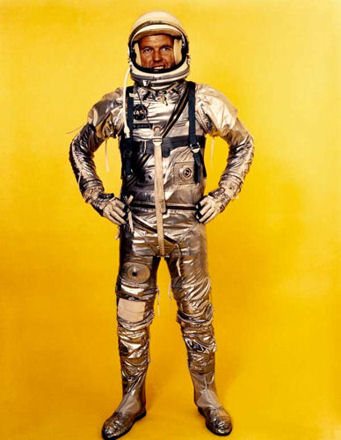
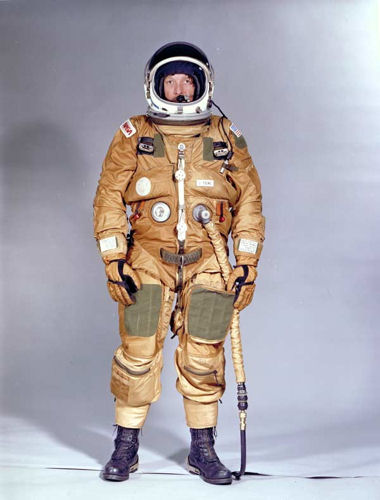
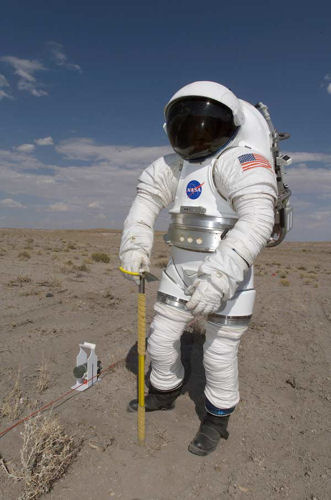
Pictured below is the evolution of
the
American
spacesuit. From left to right in the top row are the Mercury
suit
(1961), the
Gemini suit (1965), and the pre-Playtex Apollo suit (1968); in
the
lower row
are the famous Apollo magic suit (1969), the first space
shuttle suit
(1981),
and the new suit being produced for the now-defunct
Constellation
Program.
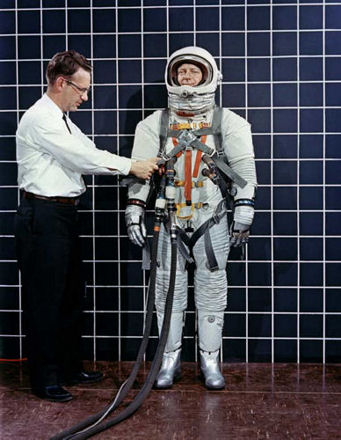
Below that, believe it or not, is an early prototype Apollo
suit. While
it may
appear to be a still from some 1950s sci-fi flick, or a
computer
generated
artist’s conception, it is, in fact, an actual suit being
tested in the



Another thing Bear Grylls would
undoubtedly
do is
bring us back some of those dazzling lunar starscapes that the
Apollo
guys
neglected to capture. Presented below, by the way, is one of
NASA’s
former astronomy
pics
of the day. It carried with it the
following explanation: “If you could turn off the atmosphere’s
ability
to
scatter overwhelming sunlight, today’s daytime sky might look
something
like
this.” Below that is a shot from deep space, illustrating that
stars in
outer
space maybe aren’t really as camera-shy as some would like us
to
believe.


According to Bolden, NASA had
“focused so
much of
our effort and funding on just getting to the moon, we were
neglecting
investments … required to go beyond.” So while we don’t have
the money
required
to get back to the Moon, you see, we do have the money to
bypass the
Moon and
fly our guys to more distant locales, like Mars. No target
date has
been set,
but I’m guessing that if we focus our attention on these
bolder
objectives,
we’ll probably succeed by, like, 2050. Or maybe 2060. Or 2069,
on the
100th
anniversary of the first alleged Moon landing.
As will be recalled, we set our
sights a
little higher
in the 1960s. When Kennedy delivered his famous declaration
back in May
of 1961
that we were going to the Moon, he gave the aerospace
community less
than a
decade to make it happen. Engineers across the country, who
were well
aware of
the fact that the nation hadn’t even taken its first
baby-steps yet,
were
understandably dismayed.
The first Apollo contract was awarded
just
two
months later, in July of 1961, for the sophisticated
navigation system
that
would allegedly guide the spacecraft to the Moon. In an
unusual move,
NASA
opted not to solicit bids for the guidance system; instead,
the
contract was
handed directly to MIT, generating “immediate controversy,” as
noted by
Moon
Machines. As one of the show’s talking-heads noted,
“There was
actually a
budding industry out there that had developed guidance systems
and
people from
industry were quite upset. They felt that they should have
been given
the
chance to bid on the contract – and a university is not
ordinarily what
the
government contracts out to build hardware for operational
systems.”
There was, alas, nothing ordinary
about the
Apollo project.
The man NASA turned to first, long
before
awarding
any of the other Apollo contracts, was one Charles Draper, who
ran
MIT’s
instrumentation lab, which would later carry Draper’s name.
Draper was
generally described as an eccentric, charismatic, colorful
gent whose
background was in physics and, curiously, psychology. He is
widely
considered
to be the father of the inertial guidance system.
Perhaps significantly, Bill Kaysing,
the
first
Apollo skeptic to gain prominence, has claimed that it was MIT
(in
conjunction
with DARPA) that provided NASA with the blueprint for how to
plausibly
simulate
manned trips to the Moon. If true, then it of course makes
perfect
sense that
NASA would have turned directly and immediately to MIT, and
would have
done so
without taking any outside bids. Until MIT completed their
work and
provided
the space agency with an outline of the project, it would
seem, NASA
wouldn’t
have known what other contracts to award.
The fact that the project landed on
the desk
of
Charles Draper is perhaps significant, given that the name
‘Draper’ is
a rather
notorious one in twentieth century American history – and one
that is
closely
tied to the name ‘Bush.’ It is a name that appears more than
once on
the
membership list of everyone’s favorite secret society, Skull
&
Bones
(Herbert Draper Gallaudet [1898], Arthur Draper [1937],
William Draper
III
[1950]). It is a name that was prominently featured in the
American
eugenics
movement, with General William Draper, Jr. serving as founder
and
chairman of
the Population Crisis Committee and vice-chairman of the Birth
Control
League
(as Planned Parenthood was originally known). General Draper,
a close
friend of
the Bush family, also helped finance the 1932 International
Eugenics
Conference. Many years later, during the Apollo era, Draper
advised LBJ
on
population reduction strategies.
The Draper family was also, not too
shockingly,
involved in the financing and maintenance of the Nazi regime.
General
Draper
joined Dillon Read in 1927 and for many years was tasked with
personally
handling the account of Nazi industrialist/financier Fritz
Thyssen. At
the
close of WWII, Draper was appointed Chief of the Economic
Division of
the Joint
Allied Control Council for
One final note about General Draper
(whose
son,
Bonesman William Draper III, served as the chief of
fundraising for
George
Bush’s 1980 presidential campaign): he was a member of the
Society of
American
Magicians. In other words, William Draper, Jr. considered
himself to be
something of an expert in the art of illusion. Perhaps the
same could
be said
of Charles Draper of MIT.
According to Moon Machines,
Draper
and his
team got to work on the Apollo guidance system in the spring
of 1962.
Given
that Moon Machines also contends that the contract was
awarded
to MIT in
early summer of 1961, the question that is naturally begged
is: why,
with the
clock ticking and with an absurdly short timeframe to pull the
Apollo
project
together, would the MIT team have waited almost a year to get
started?
Or did
they, in fact, spend that first year working on their real
assignment –
mapping
out the key elements of the simulation?
If so, then they apparently spent a
fair
amount of
time viewing an obscure German silent film by the name of Die
Frau
im Mond
(The Woman in the Moon), as noted in the painfully long
documentary, What
Happened on the Moon? The German feature film, released
by
filmmaker Fritz
Lang in 1929, provided the blueprint for the heavily
ritualized launch
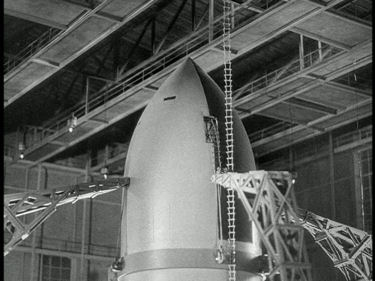
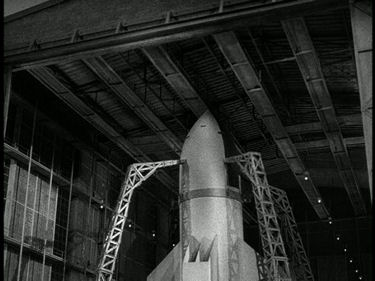
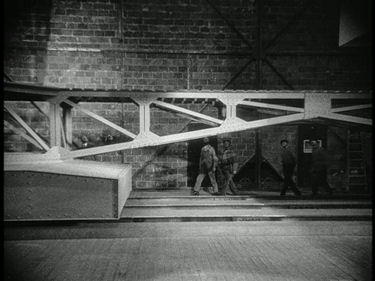
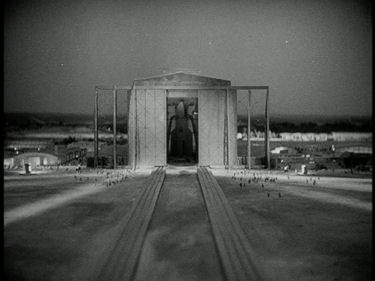
procedures that were adopted for the Apollo program. As can be
seen in
the
screen caps below, all of the elements were there: the
unnecessary
vertical
construction of the spaceship in a specially built hangar; the
grand
opening of
the massive hangar doors; the excruciatingly slow roll-out of
the
upright
rocketship from the hangar to the launch pad; the raucous
crowds
watching the
spectacle live; the now ubiquitous countdown; even the
shedding of two
stages
of the ship. In other words, the only elements of the
performance that
the
public ever actually witnessed were all lifted directly from a
forty-year-old
silent film.
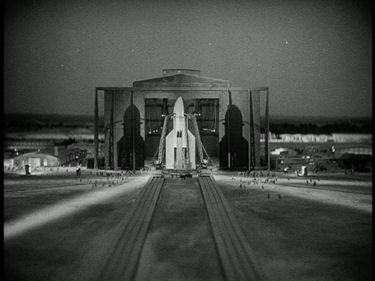

Fritz Lang’s technical adviser on the
film
was
Herman Oberth, considered to be one of the three founding
fathers of
rocketry.
Assisting Oberth on the film project, according to the
previously
quoted Time-Life
book To the Moon, was one of his brightest students,
nineteen-year-old
Wernher von Braun. A decade-and-a-half later, both Oberth and
von Braun
would
be scooped up through the Paperclip project and brought to
America to
work on,
among other things, the Apollo program, whose choreography
just
happened to
very closely match that of the fake Moon launch Oberth and von
Braun
had
crafted forty years earlier.
Die Frau im Mond, by the way, was not the only Fritz
Lang
film that proved to be rather prophetic. He followed it up in
1931 with
M,
the tale of a sadistic, pedophilic serial killer guided by
voices in
his head.
I wonder how he came up with that plotline?
Before moving on, I should probably
point out
here
yet another brazen lie the ‘debunkers’ like to tell – the one
that
holds that
von Braun was only a Nazi because he had little choice in the
matter,
what with
living and working in Germany during the days of the Third
Reich and
all.
That’s a nice little fable, to be sure, but it is contradicted
in a big
way by
at least one known photograph in which von Braun can be seen
adorned in
the
elite Nazi regalia of the Black Order of the SS. As anyone who
has
studied the
Nazi hierarchy is well aware, Himmler’s elite order had a ‘no
weekend
Nazis
need apply’ policy.

Anyway, returning to MIT, the
starting point
for
engineers was to develop a gyroscope-based guidance system.
The problem
though
was that gyros could not be produced to MIT’s exacting
standards,
resulting in
gyro after gyro being rejected. Another problem was that
translating
data from
the gyros into flight instructions would require, as Moon
Machines
noted, a “modern digital computer,” and putting such a beast
in a
spaceship
“was an entirely new challenge.”
“Computers in the early 1960s,” you
see,
“were huge.
The idea of squeezing such a monster into a spacecraft seemed
preposterous.”
But that wasn’t really going to be a problem since, as we have
already
seen,
clearing seemingly insurmountable obstacles was something that
the
aerospace
community was uniquely skilled at in the 1960s. The engineers
working
on the
onboard computer utilized an entirely new technology known as
the
silicon chip.
The technology was so new though that no one knew what it
could
actually do.
And as with the gyros, it proved to be nearly impossible to
produce
chips of
acceptable quality.
At the time, ‘software’ was a
virtually
unknown
concept. As Moon Machines duly reported, “With nobody
clear on
exactly
what the computer should do, the software engineers were free
to write
almost
anything they liked.” One of those flight software developers,
Alex
Kosmala,
made the following remarkable admission: “There were no specs.
We made
it up.
Uhmm … and it’s always [been] amazing to me – why was I allowed
to
program
something that hadn’t even been specified [but] that would be
critical
in assuring the success of the whole Apollo Program? I
couldn’t
believe
it, but that’s the way it was. We made it up as we went
along!”
I’m going to take a wild guess here
and say
that
NASA probably wasn’t unduly concerned since the functioning of
the
software
would only have mattered if the agency was planning to
actually send
guys to
the Moon.
The most complicated aspect of the
Apollo
missions
was the landing of the lunar modules, which made the software
program
controlling that part of the mission the most difficult to
design.
Amazingly
though, that aspect of the software design was not assigned
until after
most of
the other programs were 2/3 complete – and it was assigned to
a
twenty-two-year-old gent named Don Isles who had just recently
started
his very
first job. According to Moon Machines, “the program
without
which it
would be impossible to land on the Moon … had been written
almost as an
afterthought by a junior engineer.”
It is rumored that MIT first tried to
pawn
the job
off on a kid who flipped burgers at the local McDonalds, but
he
apparently had
prior commitments.
By mid-1966, Draper’s dream of
controlling
the
entire mission via an onboard computer had been dropped in
favor of an
Earth-based control system with the Draper system along as
back-up. MIT
allegedly produced a computer the size of a small fridge,
which both
the
command module and the lunar module were outfitted with.
Despite the
overwhelming obstacles faced by the MIT team, and the
seemingly
lackadaisical
approach taken with the project, the Apollo guidance system,
as would
be expected,
performed nearly flawlessly on every outing.
One final note here on Die
Frau im
Mond before wrapping up this installment: the
gatekeepers over
at the BAUT
forum appear to be in on the joke. Why else would the
site's logo
contain not an image of NASA's lunar module sitting on the
surface of
the Moon, but rather a rocketship that looks suspiciously like
the
spaceship from Lang's film?