

Wagging the Moondoggie, Part XIV
May 12, 2011
by David McGowan
Yeah, I know, I know – a lot of you were expecting, and have been waiting somewhat patiently for, and have probably even been promised, a new installment of the Laurel Canyon series. And I will readily admit that I did say, with the launch of the last Apollo installment, that I was done with this topic for now. But how was I supposed to know that just four months after that launch, it would be announced, albeit so quietly that almost all of you probably missed it, that we will be boldly taking another stab at sending men to the Moon?!
So no, we have not quite resumed our journey through Laurel Canyon, but because I’m all about the giving, we’re going to take one more quick trip to the Moon! And on the way there, there is a very high probability that we will encounter some advertisements. Because, like I said, I’m all about the giving. And I thought to myself the other day, “what more can I give them?,” and the answer that I came up with was, “I know! I’ll randomly and rather awkwardly insert some cool ads!”
Anyway, as I noted in the last Apollo post, “whenever NASA types talk about going ‘back’ to the Moon,” they invariably seem to “unintentionally raise questions about the legitimacy of the Apollo missions.” And sure enough, the boys over at Lockheed Martin (one of NASA’s longtime partners-in-crime) certainly didn’t let me down in that regard with this latest proposal.
Before proceeding, I should probably first clarify here that the proposed missions are not so ambitious as to involve actually landing on the Moon. No, these proposed missions involve merely flying to the Moon’s far side and then sort of hanging out in Lunar orbit for a couple of weeks. In other words, all of the most technologically demanding aspects of the alleged Apollo missions – like actually landing on the Moon, surviving on the Moon, lifting off from the Moon, and docking while in Lunar orbit – have been eliminated.
Even these far less ambitious missions, of course, won’t actually happen – but let’s play along while Space.com’s “Space Insider Columnist,” Leonard David, fills us in on what we have to look forward to (“Mission Proposed to Send Astronauts to the Moon’s Far Side,” November 23, 2010):
“While NASA has officially given up its plans to send humans back to the surface of the moon anytime soon, a contractor is proposing a mission to send a crew to a stationary spot in orbit over the far side of Earth's neighbor. Lockheed Martin has begun pitching an L2-Farside Mission using its Orion spacecraft under development … The Earth-moon L2 Lagrange point is where the combined gravity of the Earth and the moon allows a spacecraft to hover over one spot and be synchronized with the moon in its orbit around the Earth. From a halo orbit around that L2 point, a crew would control robots on the lunar surface. Teleoperated science tasks include snagging rock specimens for return to Earth from the moon's South Pole-Aitken basin – one of the largest, deepest, and oldest craters in the solar system – as well as deploy a radio telescope array on the farside.”
Everybody got all of that? Sounds pretty easy, doesn’t it? After all, the bar has been set substantially lower than it was in the glorious 1960s, when we easily mastered such things as landing men on the Moon, walking on the Moon, driving dune buggies on the Moon, and playing golf on the Moon. Nevertheless, there are some potential problems – just as there are, as is usually the case, some aspects of these proposed missions that directly contradict the entrenched, though slightly insane, belief that we sent men to the Moon back in the days when telephones were heavy enough to be used as lethal weapons.
Let’s begin with one of the stated benefits of these proposed missions, as listed in a Lockheed Martin ‘white paper’ and laid out by Daniel Bates of the UK’s Daily Mail (“Astronauts to be Sent to the Far Side of the Moon for First Time in 40 Years in Pre-Mars Mission,” November 25, 2010): “Both [NASA and Lockheed Martin] would also have the chance to address the problem of a higher re-entry speed which is accumulated on trips further away from the Earth.”
There they go again, pretending as though we’ve never done this before! Already we have heard from NASA types about how we haven’t yet solved the radiation problem, and how we haven’t yet developed spacesuit materials capable of withstanding the temperature extremes on the Moon, and how we haven’t yet solved the problem of how to deal with all that Lunar dust … and now we find that we apparently also haven’t yet worked out how to deal with the fact that spacecraft returning from the Moon would have to survive much higher re-entry speeds than spacecraft returning from low-Earth orbit! And I’m guessing that we might also have a problem with controlling the all-important reentry angle.
At this point, I really am beginning to wonder if there is any of that classic 1960s space technology that hasn’t been lost? Perhaps NASA needs to hire a crack team of archeologists to dig through their warehouses.
Another problem arises from the proposed duration and timeline of the missions. According to Space.com, “Each flight would prove out the Orion capsule’s life support systems for one-month duration missions.” Later in the same article, we find that on each mission, our fearless astronauts “would orbit the L2 point for about two weeks.” It would appear then that Lockheed and NASA are allowing a full two weeks to travel to and from the Moon – which would be all well and good were it not for the obvious fact that it is roughly twice the time that it took for the mighty Apollo craft to allegedly get to the Moon and back!
The 1960s was, as some will surely recall, the era of ‘muscle cars,’ so perhaps it was the era of ‘muscle spaceships’ as well. But since we have now apparently sacrificed raw power in favor of fuel economy, I guess today’s spaceships just don’t burn rubber like the spacecraft of the wild and wooly ‘60s – though there is, I suppose, an alternative explanation: the last forty years of space research has taught us that it would actually take twice as long to get to the Moon as was believed back when we faked the Apollo flights.
According to Josh Hopkins of Lockheed Martin, in order to achieve the not-so-lofty goal of sending men out to orbit the Moon, the company’s Human Spaceflight Advanced Programs division has “come up with a sequence of missions that [they]’ve named ‘Stepping Stones,’ which begins with flights in low Earth orbit and incrementally builds.” Lockheed views the first Orion missions as “feasible by 2016 to 2018.”
Do I really need to belabor the point that, back in the days when mankind was transitioning from the use of stone tools, we didn’t need any ‘stepping stones’ to get to the Moon – the very first manned launch of an Apollo craft allegedly flew its crew all the way there and back without a hitch! And do I also need to once again point out that, despite setting our sights much lower, and despite having vastly improved technology to work with, and despite having an additional fifty years of spaceflight experience, it will still take just as long to get men near the Moon as it did in the 1960s to actually walk on the Moon?
Returning now to the alleged benefits of running these missions, we find that Lockheed’s ‘white paper’ also talks about being able to “measure astronauts’ radiation dose from cosmic rays and solar flares to verify that Orion provides sufficient protection, as it is designed to do. Currently the medical effects of deep space radiation are not well understood, so a one-month mission would improve our understanding without exposing astronauts to excessive risk.”
So despite the fact that some forty-three years have now passed since we first allegedly sent men into deep space, we still don’t really know anything about the effects of deep space radiation … but we are pretty sure, apparently, that a thirty-day dosage is a good, safe place to start! And just to be on the safe side, we could always pull Buzz and Neil out of retirement to pilot the first flight. They can’t have too many years left in them anyway.
In all seriousness, NASA initially considered for the Apollo missions, according to “To The Moon” (a Time-Life Book), “men doomed by fatal disease.” Also considered were “midget[s], to cut the payload weight.” They said it, not me. I would have used a more politically correct term. Imagine though, if NASA had followed through on that idea, what kind of records could have been set in the Midget Toss?
One final curious aspect of these latest proposed missions that we need to delve into was explained by Space.com: “The robotic lander and rover would be launched first on a slow but efficient trajectory to the moon, to ensure that the rover is on its way before risking the crew launch.”
Say what?! Are you kidding me? What kind of girly-men are these new breed of astronauts? Stepping stones? Supplemental launches before “risking the crew”? Can’t we just find some real men like John Glenn and Alan Shepard to pilot the Orion craft? And what is this nonsense about a “slow but efficient trajectory to the moon”? “Efficient” in what way? Last time I checked, the ‘debunkers’ were still claiming that getting to the Moon was pretty much a matter of just free-falling your way there. What could be more efficient than that?
Oh wait … I remember now. As I pointed out in the last Apollo post, getting to the Moon does not actually involve free-falling. It involves battling the Earth’s gravity by flying in ever-increasing ellipses. And burning lots and lots of fuel. And Lockheed’s oblique reference to a “slow but efficient trajectory” is, in fact, a confirmation of that. And so, by the way, is this artist’s conception of the proposed Orion missions, which shows the spacecraft outside of low-Earth orbit and yet clearly still burning its engines.
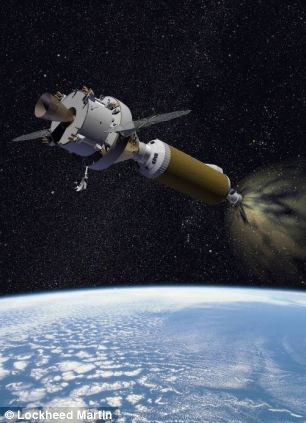
Following the launch of the lander and rover (both of which, it will be recalled, stored easily aboard the Apollo flights), “three astronauts would be launched in an Orion spacecraft. If NASA has built a heavy lift launch vehicle by then, it would be capable of launching the crew directly to the moon. If that mega-booster is a no-show, smaller rockets can be used instead, but a more complex arrangement would be required. First, Orion would be launched to low-Earth orbit on a rocket such as a Delta 4 Heavy. Then, a modified Centaur upper stage would launch on a separate rocket. Orion would dock to the Centaur stage in orbit, and the Centaur would boost Orion toward the moon.”
To briefly recap then, we now know that getting three men near the Moon in modern times is considerably more difficult than landing three men on the Moon was in ancient times. It now requires taking a number of baby-steps before taking the big plunge. And it requires the launch of three separate high-tech spacecraft. And it will take the astronauts a full week to get there, as there are now speed limits in deep space that are strictly enforced and the U.S. can not afford to have another moving violation on its record. The equipment, of course, will take even longer to get there, because it’s on a slower and more efficient course. And we may have some problems to work out in regards to deep space radiation and reentry speed.
And even after all of that, needles to say, we won’t be actually landing men on the Moon. That would probably require an additional ten years of baby-steps and the launch of at least five spacecraft. And since we’ll be checking out the far side on these proposed missions, we still won’t be able to verify all those Apollo artifacts supposedly littering the Moon. Which is really kind of a moot point, because we won’t actually be going at all.
Speaking of the far side of the Moon, by the way, the Daily Mail noted that the “surface was first photographed by Luna 3, a Soviet probe, in 1959 then the Apollo 8 mission followed in 1968 but there has been scant exploration of it since.” Translation: there has been no exploration of the far side since 1959, and it would be nice if the Daily Mail would throw in a comma now and then.
But enough about that. Let’s move on to a different topic. Remember how I argued that if it were possible to send crews to the Moon, private enterprise would have a strong financial incentive to have done so to exploit any available resources? And remember how the ‘debunkers,’ not surprisingly, claimed that there was nothing much on the Moon to see or do, especially since the strip club was shut down over some zoning dispute, so there was not really any compelling reason to go back? Well, it turns out – and this is quite shocking – that the ‘debunkers’ may be lying once again. As the LA Times reported on April 8, 2011 (W.J. Hennigan “MoonEx Aims to Scour Moon for Rare Materials”):
“A team of prominent Silicon Valley entrepreneurs are shooting for the moon with a new private venture aimed at scouring the lunar surface for precious metals and rare metallic elements. The private company Moon Express Inc., or MoonEx, is building robotic rovers alongside scientists at NASA’s Ames Research Center northwest of San Jose. MoonEx’s machines are designed to look for materials that are scarce on Earth but found in everything from a Toyota Prius car battery to guidance systems on cruise missiles. While there is no guarantee the moon is flush with these materials, MoonEx officials think it may be a ‘gold mine’ of so-called rare earth elements.”
The company won’t, naturally enough, be sending any human cargo to the Moon, because that isn’t really possible, but the point here is that there are in fact compelling reasons for ‘return’ flights to the Moon, for both financial and scientific gain, so there is no validity at all to the argument that no one has been back for some forty years simply because there is no reason to go back.
Let’s briefly return now to Operation Fishbowl, which was also discussed in the last Apollo offering. Unbeknownst to me until very recently, NPR decided to dredge up the nearly fifty-year-old high-altitude nuke tests less than two weeks before I did (Robert Krulwich “A Very Scary Light Show: Exploding H-Bombs In Space,” July 1, 2010). And the facts they brought to the table were rather compelling.
“If you are wondering why anybody would deliberately detonate an H-bomb in space, the answer comes from a conversation we had with science historian James Fleming of Colby College.” According to Fleming, who has been busily reading through James Van Allen’s papers while working on a biography, “a good entry point to the story is May 8, 1958, when James Van Allen, the space scientist, stands in front of the National Academy in Washington, D.C., and announces that they’ve just discovered something new about the planet.”
What Van Allen’s team had discovered, of course, was that Earth is ringed by belts of high-energy particles, now known as the Van Allen radiation belts. And what Fleming’s recent research revealed, incredibly enough, is that the “day after the press conference, [Van Allen] agreed with the military to get involved with a project to set off atomic bombs in the magnetosphere to see if they could disrupt it.”
Let’s pause here for a moment to reflect on the almost unfathomable level of megalomania at play here: immediately upon learning of the existence of the radiation belts, the military/intelligence complex decided, without even giving it much thought, that it would be a great idea to attack said belts with atomic weapons! And the ‘scientist’ who had made the discovery immediately agreed that that was a swell idea! As Fleming noted, “this is the first occasion I’ve ever discovered where someone discovered something and immediately decided to blow it up.”
Never mind that the belts are there to shield the planet from incoming space radiation, and that their existence is one of the primary reasons that biological lifeforms can thrive on this sphere … let’s just see if we can blow a big fucking hole in them! It apparently never occurred to the geniuses in Washington that if you blow a hole in the belts to, say, allow for the safe passage of spacecraft, you would also presumably allow for the unsafe passage of massive amounts of incoming, and very lethal, radiation.
This, dear readers, says a lot about the true nature of the men who rule behind the curtain. What hubris is required to put at risk every living creature on this planet, and do so without even giving it a second thought, for the dubious purpose of facilitating space missions that were never going to actually take place? And bear in mind, by the way, that these ‘tests’ took place during the tenure of a nearly mythical figure known as John Fitzgerald Kennedy. For those then who are inclined to believe that the sitting President actually calls the shots, I would suggest taking a little time to contemplate why it is that the man who many consider to have been a knight-in-shining-armor was the man who gave the thumbs-up to the most recklessly arrogant nuclear weapons tests ever conceived?
The first such tests were conducted in 1958, almost immediately after the discovery of the radiation bands. But those tests used just lowly ol’ atom bombs, and according to NPR, “Atom bombs had little effect on the magnetosphere.” Which is why in 1962, the powers-that-be decided to up the ante by using hydrogen bombs … really, really big hydrogen bombs. How big? Starfish Prime, the most ‘successful’ of the ‘tests,’ was tipped with a warhead 100 times as powerful as the bomb that leveled Hiroshima!
As detailed by NPR, “The plan was to send rockets hundreds of miles up, higher than the Earth’s atmosphere, and then detonate nuclear weapons to see: a) If a bomb’s radiation would make it harder to see what was up there (like incoming Russian missiles!); b) If an explosion would do any damage to objects nearby; c) If the Van Allen belts would move a blast down the bands to an earthly target (Moscow! for example); and – most peculiar – d) if a man-made explosion might ‘alter’ the natural shape of the belts. The scientific basis for these proposals is not clear.”
Objective “a” roughly translates to: “we had to do it to protect ourselves from those crazy Russkies!” Those with atypically long memories may recall that before the collapse of the international Communist threat neatly coincided with the rise of the international Terrorist threat, that was pretty much the all-purpose excuse for all manner of heinous activities undertaken by the Western powers. The main problem here though is that Starfish Prime was detonated at an altitude of 250 miles, roughly 50 miles beyond low-Earth orbit, and I’m reasonably certain that Soviet ICBMs weren’t designed to fly at anywhere near that altitude.
Moving on to “b,” I feel fairly confident in saying that even back in 1962, at the tender age of two, I could have provided an answer to that question, and that answer would have been: “Yes, detonating a very large hydrogen bomb will cause extensive collateral damage. Duh!”
Proceeding to “c,” I’m afraid I’m going to have to respectfully disagree with NPR on its decision to label “d” as the most peculiar. Attempting to take out Moscow in a nuclear holocaust redirected through the Van Allen belts has to rank pretty high up on the peculiarity scale. And what would be the point? Plausible deniability? “Looky what just happened to Moscow! It’s as if God himself struck a blow against the Evil Empire! I damn sure know we didn’t do it!”
As for “d,” altering the natural shape of the belts appears to have been the primary goal. Because as we all know, man can always improve upon the natural order of things. And it was immediately apparent, right from the time of their discovery, that the shape of the belts was entirely wrong for this planet. Sure, they would have been fine for, say, Mars or Venus – or even Pluto, before it was rudely kicked out of the Fraternity of Planets – but they were clearly unfit to circle this planet. So we had to try to fix them.
Luckily, we failed.
And with that, I really am now over my Apollo obsession. See you all back in Laurel Canyon!